
Is your TV the first thing everyone notices when they walk into your living room—and not in a good way? Between tangled cables, a bulky media console, and a black screen demanding all the attention, the TV wall is often the hardest-working, least-designed corner of the home. But here’s the good news: modern TV wall design 2026 is all about quiet sophistication. Today’s minimalist TV wall doesn’t fight the screen—it frames it with intention, using warm wood slats, plaster finishes, floating consoles, and soft 2700K LED backlighting. Whether you’re renting a Chicago apartment, owning a suburban home in Texas, or settling into a Los Angeles condo, these TV accent wall ideas work for your space and your budget. From renter-friendly peel-and-stick updates to high-end microcement builds, here are 15 minimalist living room TV wall ideas that elevate your space without overwhelming it.
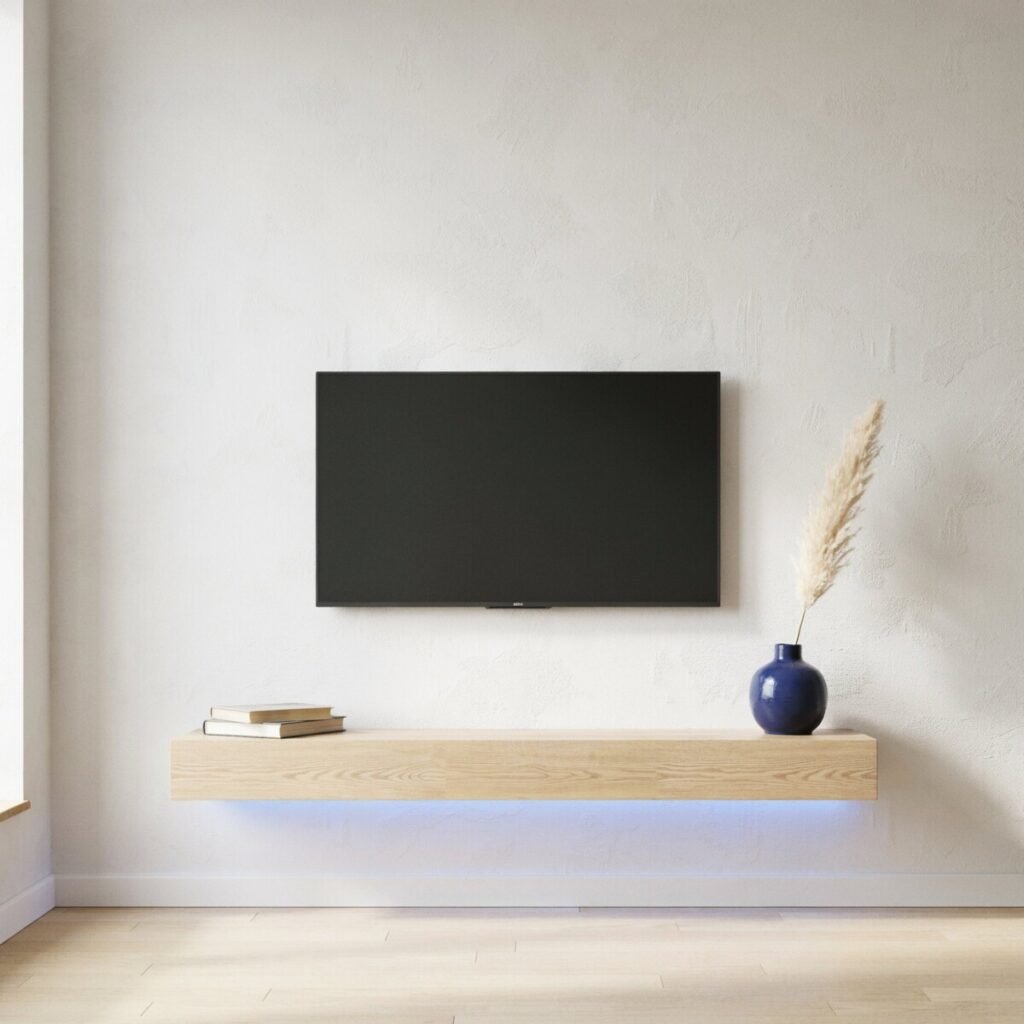
Before You Start: Planning Your Minimalist TV Wall
Give yourself 15 minutes of planning before you touch a drill. Measure your wall’s width and ceiling height, and check your viewing distance—roughly 1.5 to 2.5 times your TV’s diagonal is comfortable. Mark your mounting height now: the center of the screen at 42–48 inches from the floor for seated eye level. Choose hardware matched to your wall type—stud-rated lag bolts for drywall, masonry anchors for brick—or skip drilling entirely with a freestanding floor-stand alternative if you rent. Finally, plan the cable route: an in-wall power kit, a surface cord channel, or a hidden chase behind a console. Deciding this now prevents patched holes and frustration later.
💡 Pro Tip: Running cords inside the wall? Use a fish tape tool to pull cables through stud bays cleanly—and always use an in-wall rated power kit, never a standard extension cord.
15 Minimalist TV Wall Accent Ideas
1. White-on-White Disappearing Wall
If your goal is a TV that politely recedes, the white-on-white approach is the ultimate minimalist TV wall move. Paint the accent wall, baseboards, trim, and any built-ins the same soft, warm white, then mount the screen as flush as you can. When the TV is off, the dark rectangle reads like a piece of modern art against the bright field, and the whole wall feels calmer and bigger. Choose a matte or eggshell sheen so daylight doesn’t bounce glare into the screen. This is the dream budget-friendly, DIY-friendly starting point: one gallon of quality paint, a free afternoon, and basic tools. It works in dim apartments and sun-soaked California bungalows alike, and it pairs beautifully with warm minimalist decor like linen curtains and light oak floors.
Pro tip: Paint built-ins the exact same color and sheen as the wall—matching both makes the TV zone feel architecturally integrated.
2. Floating Console with Hidden Cable Channel
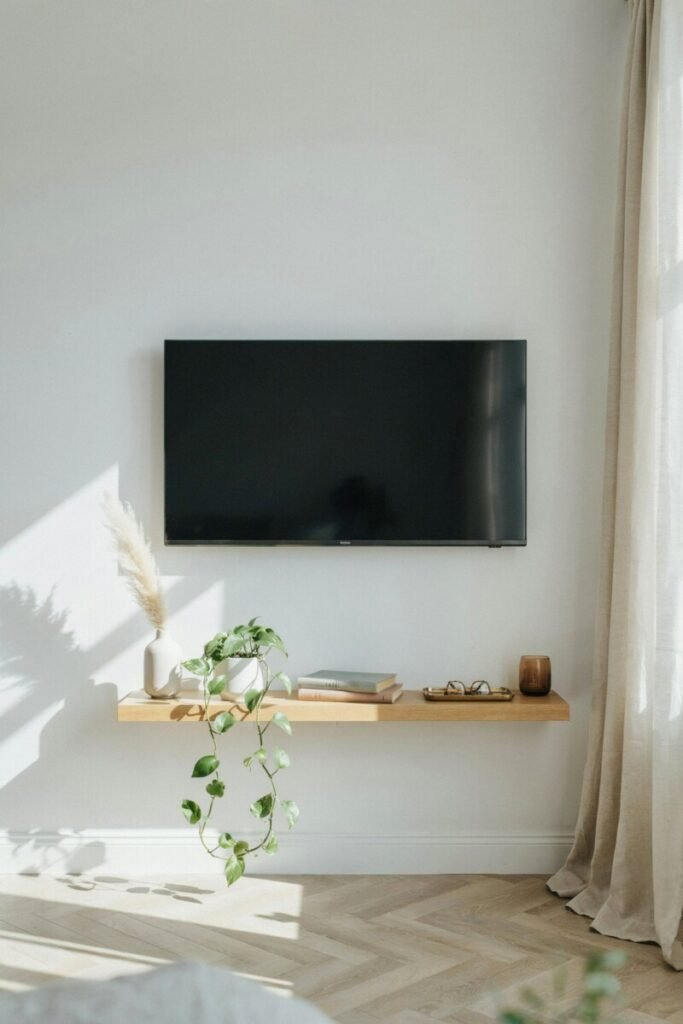
Tired of tangled wires ruining your clean aesthetic? A floating TV console is the workhorse of the minimalist living room TV wall: it lifts storage off the floor, visually expands your square footage, and gives remotes, consoles, and throw blankets a home behind clean, handle-free fronts. Look for units with built-in cable channels or rear cutouts so cords drop straight from the screen into the cabinet—no draped wires, ever. Keep the console 8–12 inches wider than the TV on each side for balance. It’s smart cable management for TV in any modern American living room design, and ready-to-hang units are easy to find at Wayfair, Home Depot, or Lowe’s.
Pro tip: Leave 6–8 inches of clearance beneath the console for a lifted, airy look—and so robot vacuums glide underneath.
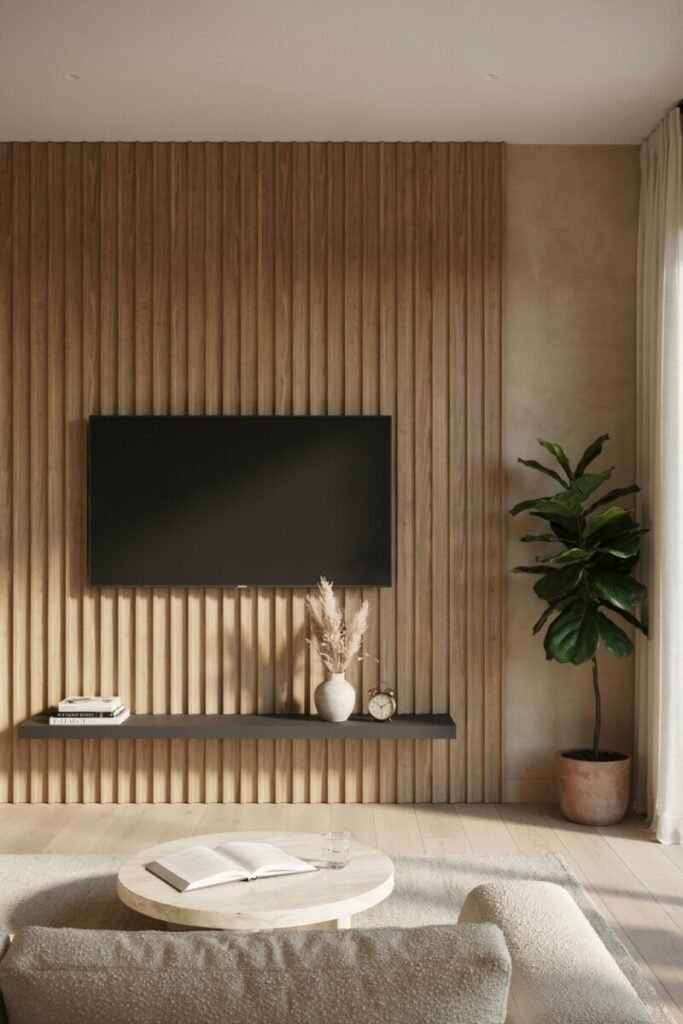
3. Vertical Wood Slat Backdrop
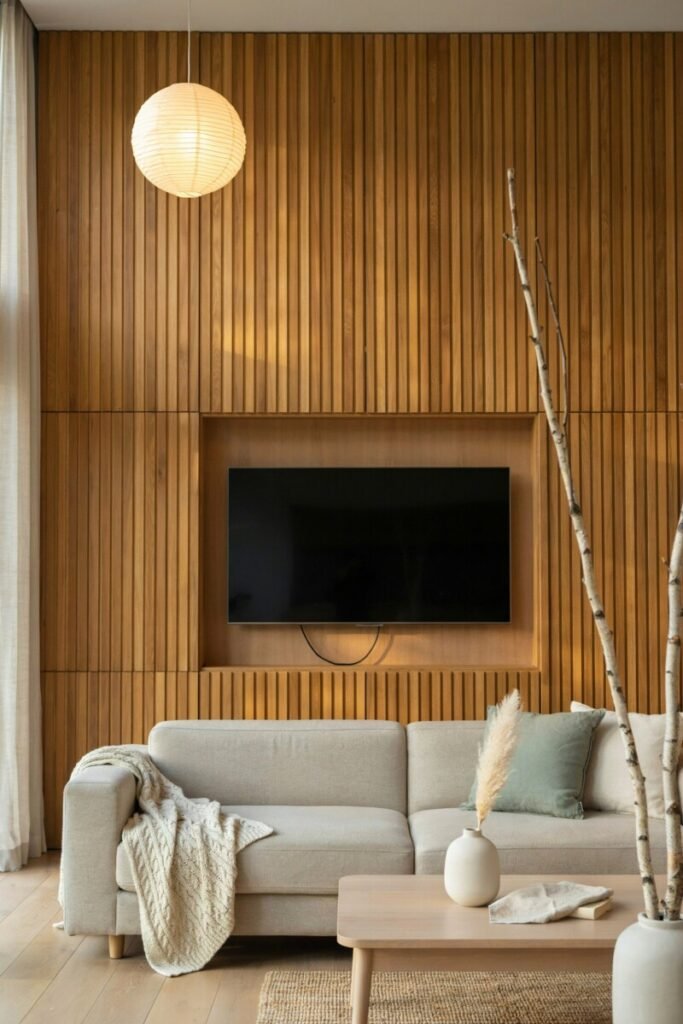
Few TV wall panel ideas add warmth as fast as vertical wood slats. The rhythmic lines of a wood slat TV wall draw the eye upward, soften room acoustics, and give a black screen a natural, textured frame—core to the Japandi TV wall look that keeps defining warm minimalism in 2026. Install real wood or MDF slats over acoustic felt, or go renter-friendly with peel-and-stick slat panels that remove without damage. Run slats floor-to-ceiling for drama, or just behind the screen for a lighter touch. It’s a favorite everywhere from Chicago lofts to Texas new builds.
Pro tip: Stain slats within two tones of your floor color so the wall feels continuous, not busy.
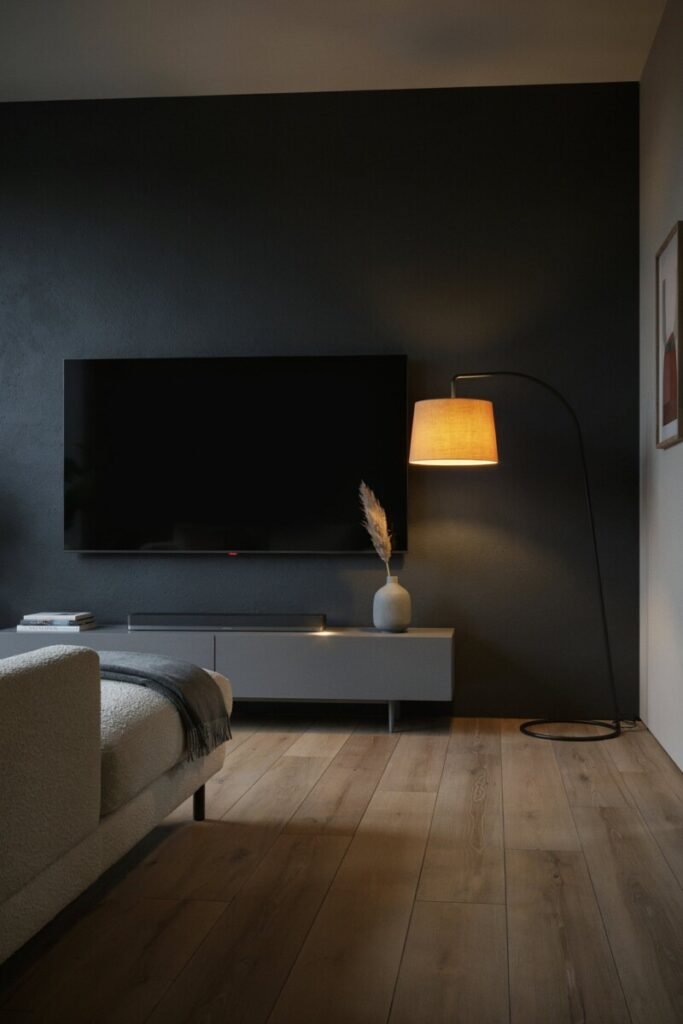
4. Matte Black Statement Wall
A matte black or deep charcoal accent wall makes the screen vanish when the credits roll—one of the boldest wall-mounted TV ideas, and paradoxically one of the calmest. With the TV off, the screen melts into the dark field; with it on, the picture pops edge to edge. Flat, matte sheens kill glare, which makes this a winner for movie nights in Florida family rooms and city studios alike. Balance the depth with warm 2700K lighting, a light-colored rug, and one natural wood element so the wall reads moody, not cave-like.
Pro tip: Choose a true matte (flat) finish—any sheen will catch lamp light and outline your TV’s rectangle.
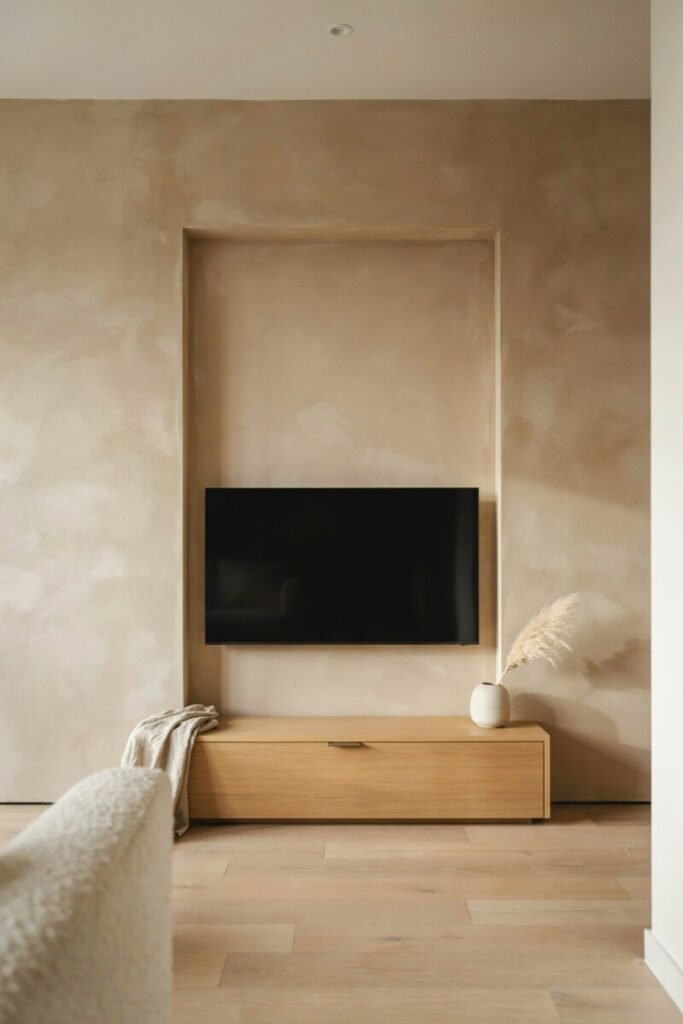
5. Recessed Plaster Niche
Here’s the higher-end hero of the list: a recessed plaster finish TV niche that seats the screen perfectly flush, as if the television grew out of the architecture. A pro frames the opening about 2 inches larger than the TV on all sides—for airflow and future upgrades—then finishes the surround in limewash, Venetian plaster, or microcement. A microcement TV wall catches light in soft, cloudy movement that flat paint simply can’t match. It’s a real investment, but this single move delivers the seamless, gallery-quiet wall that luxury American interiors are embracing right now: no console, no clutter, just shadow lines and texture.
Pro tip: Plan niche depth early—most TVs plus a slim mount need 3–4 inches to sit truly flush.
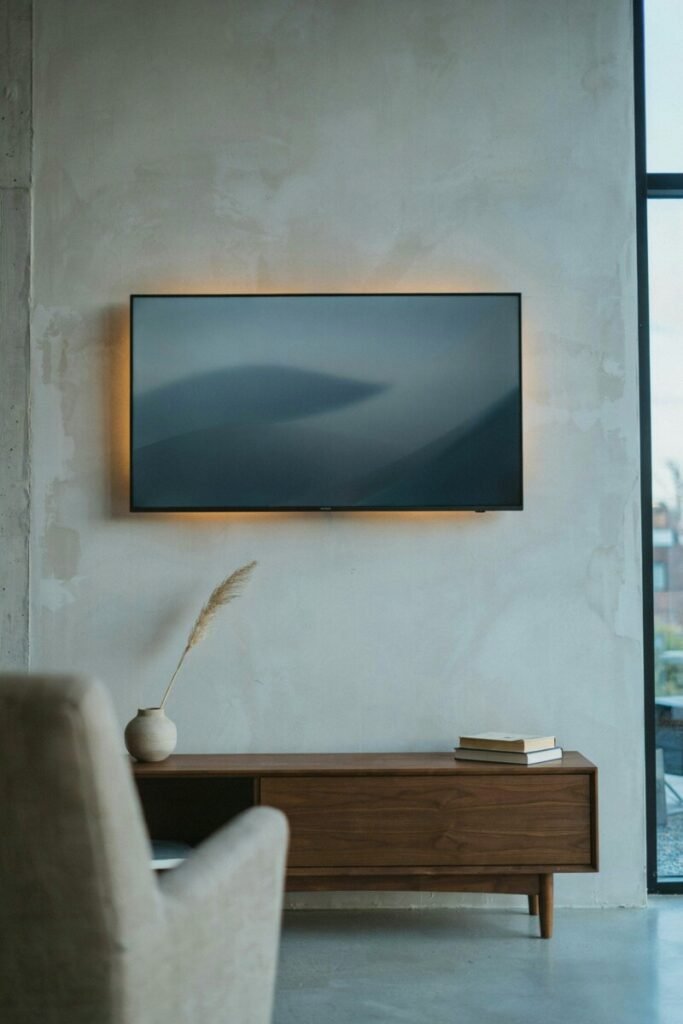
6. LED Halo Backlighting
LED backlighting for TV is the fastest, cheapest glow-up on this list—a DIY-friendly, renter-friendly win under $50. Stick a dimmable 2700K LED strip around the back edges of the panel and you get “bias lighting”: a soft halo that reduces eye strain when watching a bright screen in a dim room, while making the wall feel layered and intentional. It flatters every backdrop on this list, from a white minimalist TV wall to wood slats. Choose a plug-in kit with a remote or app dimmer so you can set the glow from movie-night subtle to party-soft.
Pro tip: Center the strip behind the panel’s middle, not its edges, so the halo peeks out evenly on all four sides.
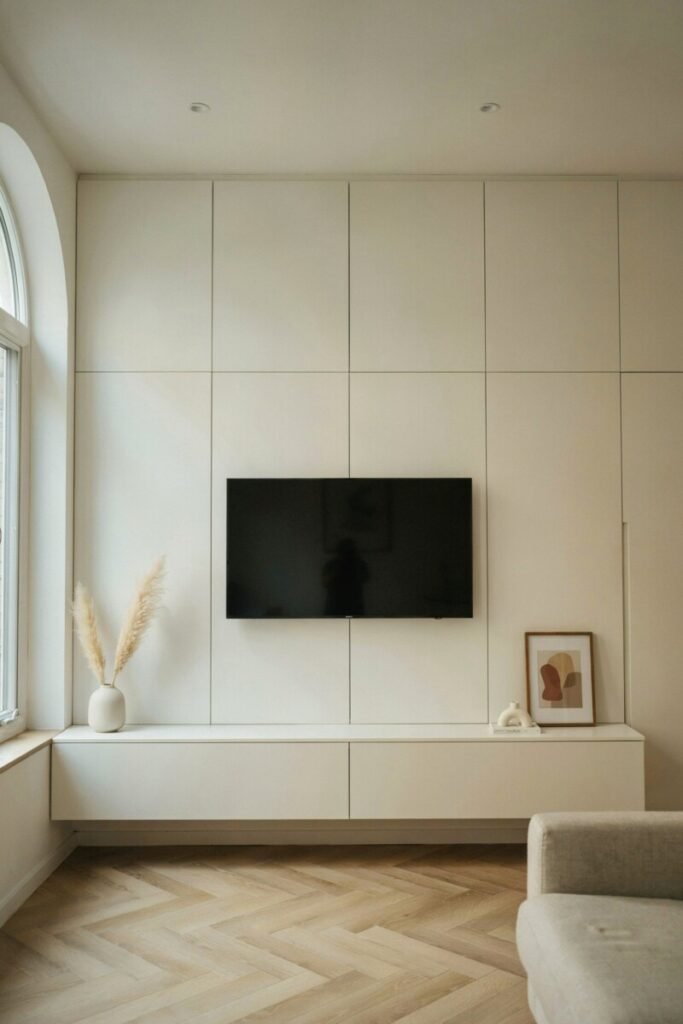
7. Integrated Flush-Mount Storage
A hidden storage TV wall with cabinetry built flush to the wall turns clutter into architecture. Think full-height panels or a run of low cabinets that sit perfectly flat, painted the same color as the wall so the entire media wall with storage reads as one quiet plane. Push-latch doors swallow game consoles, board games, and the charger drawer, while shallow reveal lines hint at the craftsmanship. This is custom-cabinet territory—ideal for suburban homes where the living room doubles as playroom and hosting space—and it’s the kind of built-in that adds real resale value.
Pro tip: Paint cabinet fronts, frames, and wall the same color and sheen; mixed sheens are what give built-ins away.
8. Curved Minimalist Feature Wall
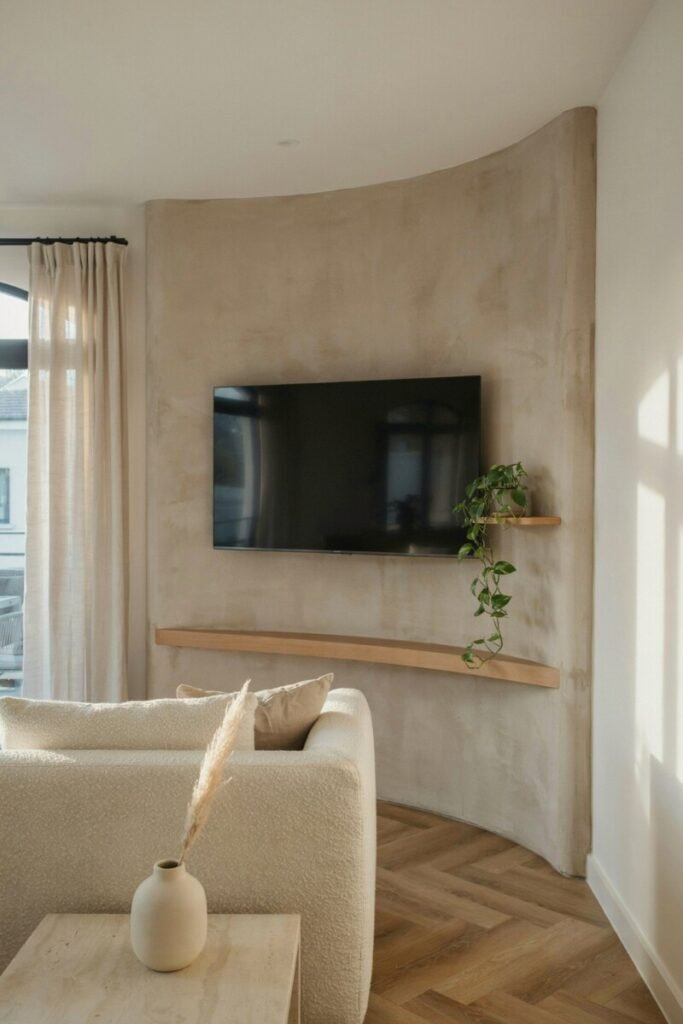
Straight lines have ruled minimalism for a decade, but curved TV wall design is 2026’s soft plot twist. A gently arced feature wall—built from flexible plywood, curved plaster, or molded microcement—cradles the screen and echoes in rounded sofas or arched mirrors. The curve catches afternoon light in a gradient no flat wall can, adding depth without a single extra object. Keep the arc shallow so a standard low-profile mount still works, and let the curve extend just 12–18 inches beyond the TV on each side. It’s a sculptural, higher-end gesture that makes a new build feel custom.
Pro tip: Echo the curve in one soft element—a round rug or boucle ottoman—so the shape feels intentional, not accidental.
9. Gallery Wall Integration
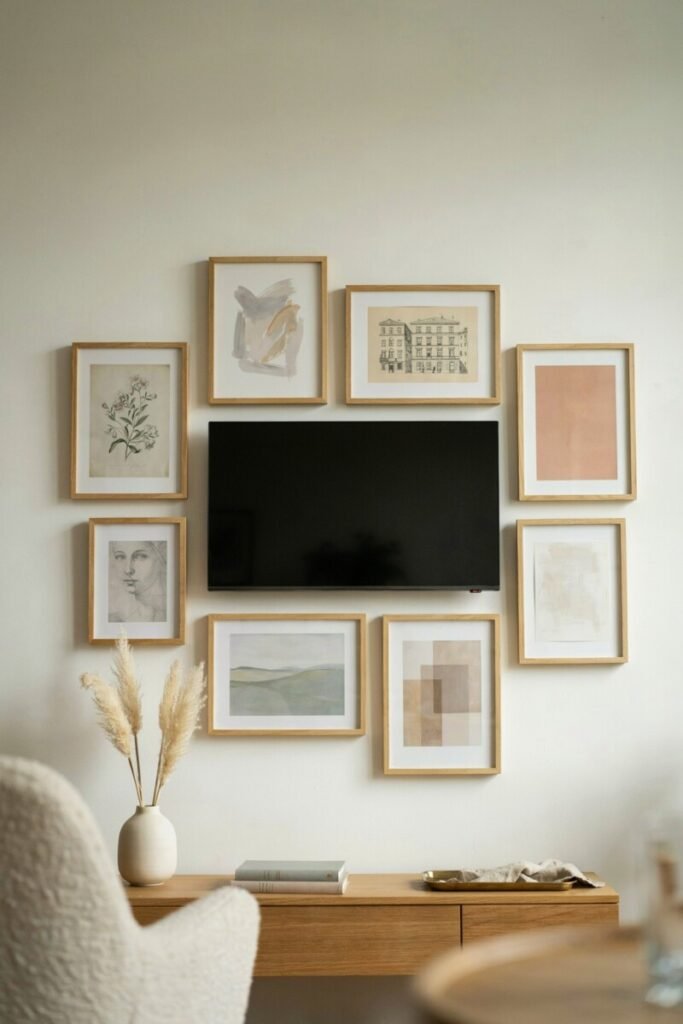
A gallery wall around TV treats the screen as one member of a curated grid: surround it with frames in matching finishes, wide neutral mats, and calm line drawings or photography so the television reads as another piece of art. Lay the arrangement on the floor first, keep spacing consistent at 2–3 inches, and align the screen’s centerline with the gallery’s visual center. And it’s genuinely renter-friendly: use removable adhesive strips rated for your frames’ weight and your deposit stays safe. This is one of the most charming apartment TV wall ideas for New York or Chicago walk-ups with big walls and zero storage.
Pro tip: Stick to one frame finish—thin oak or matte black—and let the art’s palette pull from your sofa and rug.
10. Painted Color Block Frame
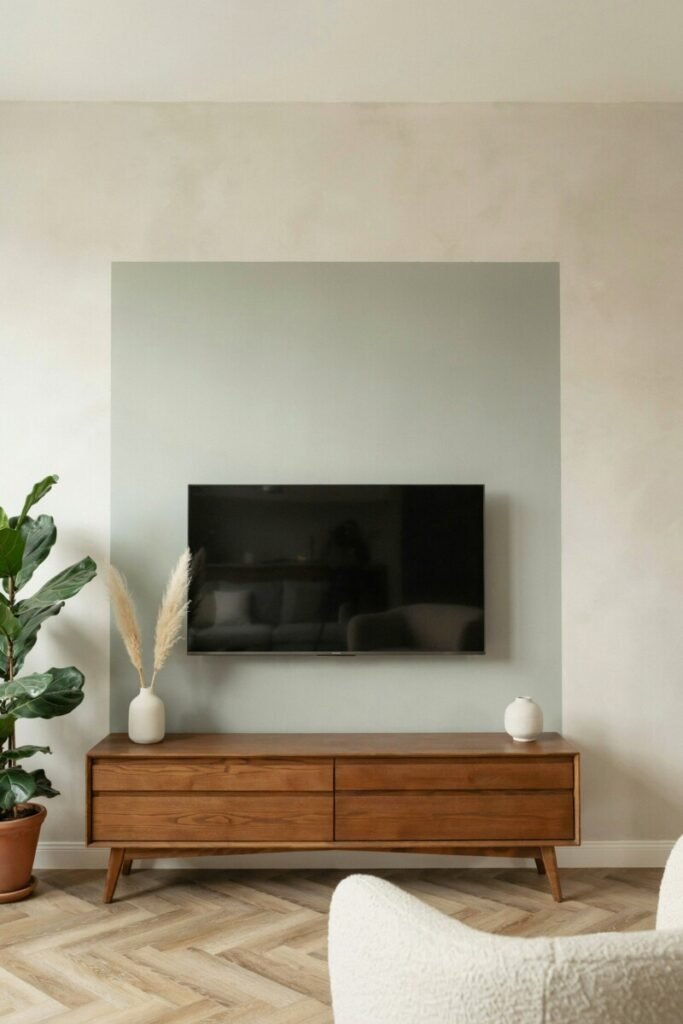
The budget-friendly TV wall makeover with the biggest visual payoff requires only painter’s tape and a quart of matte paint. Paint a crisp rectangle 8–12 inches larger than the TV on all sides in a muted, grounding tone—sage, greige, ochre, or clay—and mount the screen centered inside it. The block works like a mat around a photograph, anchoring the TV and zoning your seating area without adding a single object. It’s weekend-DIY friendly, renter-reversible, and perfect for renters and first-time owners alike. In open-plan layouts, the color block quietly announces: the living room starts here.
Pro tip: Sample your color at night and by day—muted tones can shift surprisingly under 2700K bulbs versus daylight.
11. Digital Art Frame TV Setup
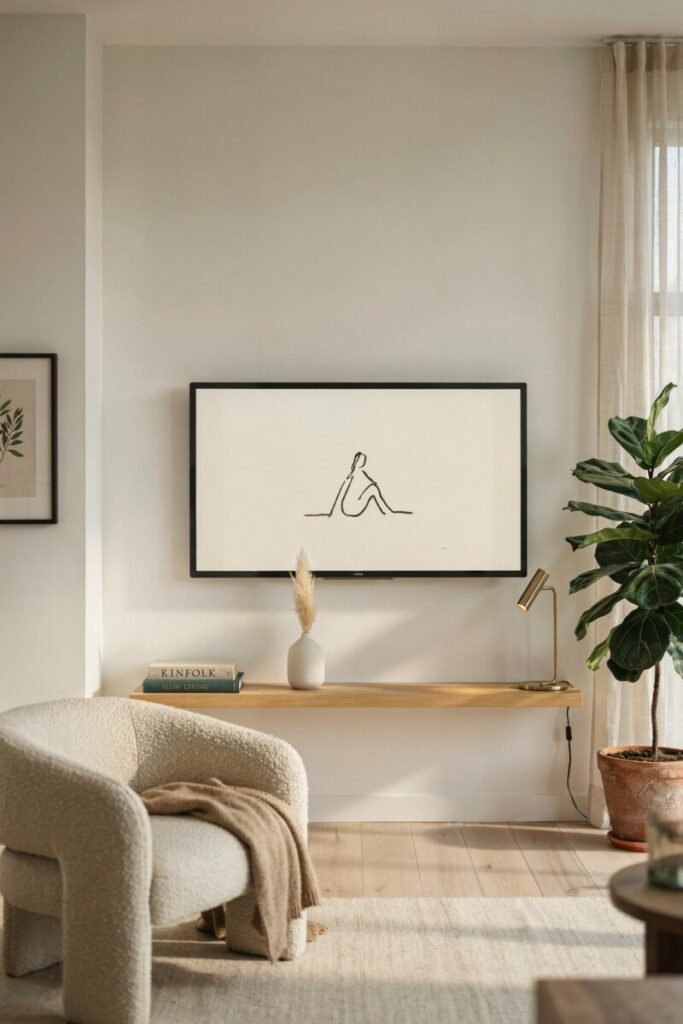
What if your TV pretended to be art full-time? Frame-style displays show rotating artwork, family photos, or calm abstracts on matte screens, with bezels that read like real frames in oak, white, or walnut. If a Frame TV isn’t in the budget, most modern TVs ship with an “art” or “ambient” mode—pair it with a slim matte frame kit and you’re most of the way there. Choose artwork whose background matches your wall color so the screen truly recedes, and set brightness to auto-dim. It’s the minimalist media unit philosophy applied to the screen itself.
Pro tip: Rotate a small playlist of 5–6 images with generous negative space; busy artwork makes the wall feel cluttered.
12. Mixed Material Composition (Wood + Metal + Plaster)
Warm minimalism loves a quiet conversation of materials. Layer three textures—a plaster or limewash field, a partial wood slat panel offset to one side, and a single slim black steel shelf—and the TV wall gains depth without one knickknack. The trick is restraint: one dominant material (about 60%), one secondary (30%), one accent (10%), all in a neutral palette. Then repeat the accent elsewhere, like black metal in a floor lamp or table legs, so the composition feels designed, not decorated. This layered approach suits modern American living room design, where open plans need zones defined by texture, not walls.
Pro tip: Offset the slat panel to one side instead of centering it—asymmetry keeps the composition curated, not template-like.
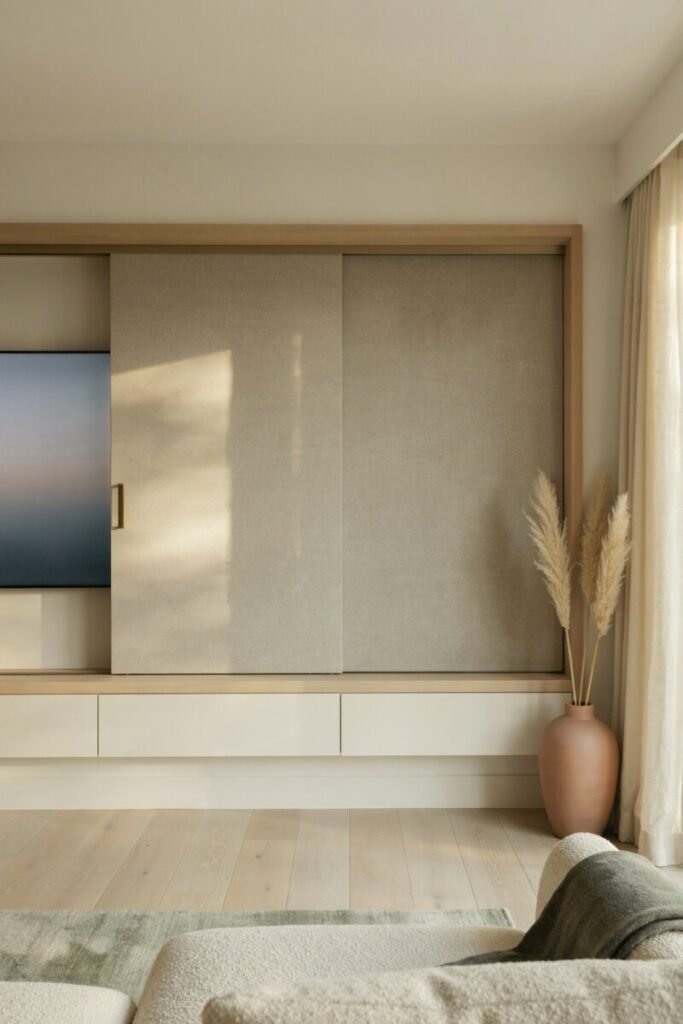
13. Sliding Panel or Hinged Art Concealment
The ultimate disappearing act: conceal the television completely behind a sliding panel or hinged artwork. On a track system, a linen-wrapped or plaster-textured panel glides across the recessed screen; in a hinged version, one large framed piece swings open at movie time. Closed, your media wall is seamless architecture or a single great artwork—perfect for studio apartments where the living room is also the office, bedroom, and yoga room. This is a higher-end custom build that demands quality soft-close track hardware and precise carpentry, but no other idea on this list transforms a room so completely.
Pro tip: Size the panel 2–3 inches larger than the screen on every side so no dark edge peeks through when closed.
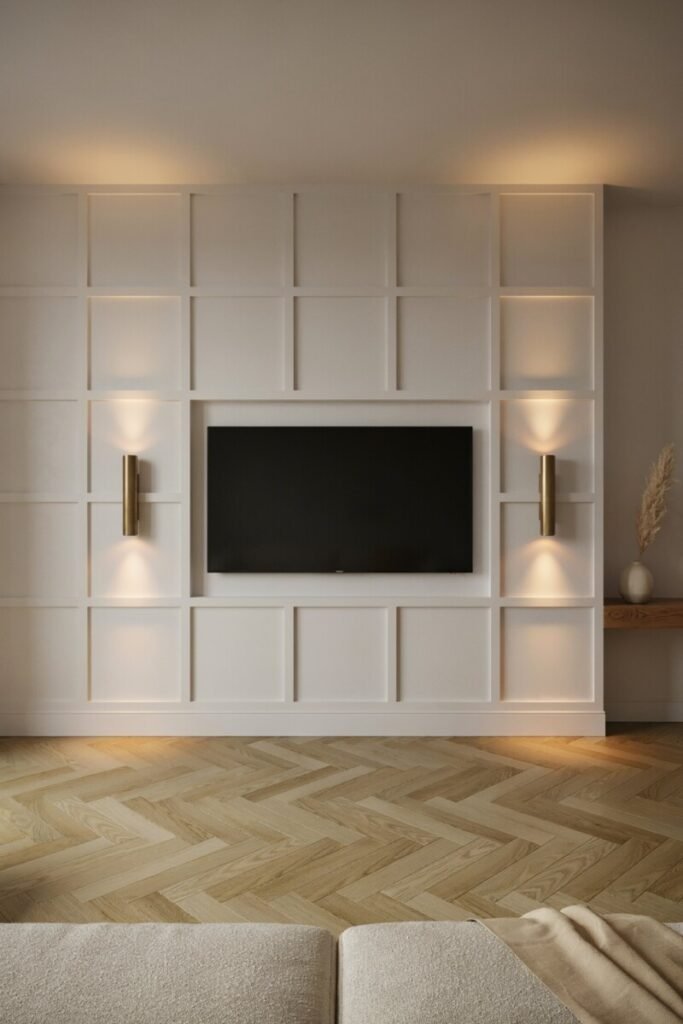
14. Square Grid Millwork with Sconces
Square grid millwork—thin battens forming a quiet checkerboard of trim—brings classic craftsmanship to a minimalist TV wall without ornate fuss. Painted the same color as the wall, the grid reads as texture, not pattern, and gives the mounted screen a tailored, architectural backdrop. Flank the TV with two slim sconces for symmetry and a soft evening glow; plug-in sconces with discreet cord channels mean no electrician required. The look bridges traditional and modern—ideal for older suburban homes with character, or newer apartments that lack it. Lightweight battens can even mount with heavy-duty adhesive strips.
Pro tip: Keep battens thin (1–1.5 inches wide) and the same color as the wall so the grid whispers instead of shouts.
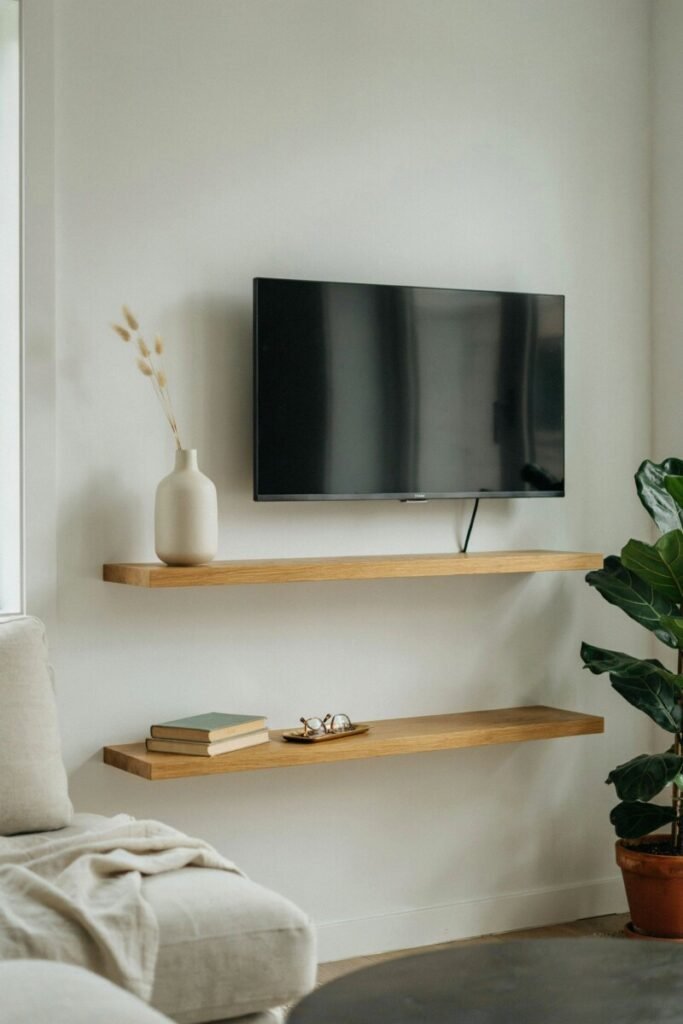
15. Corner TV Moment with Floating Shelves
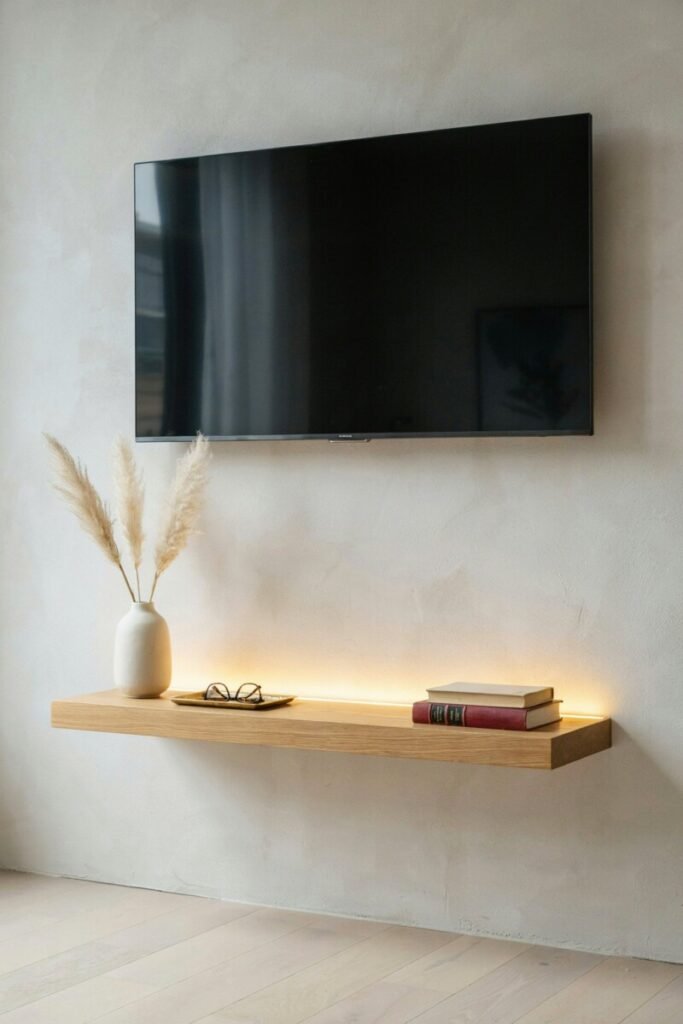
Not every room wants the TV on the main wall—and small space TV wall strategy often means claiming a corner. Mount the screen on a swiveling arm angled 30–45 degrees into the room, then balance the adjacent wall with two shallow floating shelves (8–10 inches deep) styled with one vase and one stack of books—nothing more. The corner placement frees your primary wall for a sofa or art, reduces window glare, and makes a tight layout feel deliberate. It’s among the smartest apartment TV wall ideas for Los Angeles studios and New York one-bedrooms where every floor foot is prime real estate.
Pro tip: Keep the corner’s palette tonal—wall, shelves, and decor in the same family—so the angle reads calm, not cluttered.
Common Mistakes to Avoid
Even beautiful concepts fail on execution. The most common error is mounting the TV too high—the screen’s center belongs at seated eye level, 42–48 inches from the floor, not at gallery height. Second: skipping cable management for TV; one visible cord can undo a $5,000 wall. Third: choosing a console narrower than the screen, which makes the TV feel top-heavy; aim for 8–12 inches wider per side. Also avoid glossy paint sheens that glare, overstuffed shelves that sneak clutter back in, and sealed niches without airflow that trap heat. And always check what’s behind the drywall—plumbing, ducts, and electrical lines love to hide exactly where you want to drill.
Conclusion: Start Small, Think Intentional
You don’t need a full renovation—or any renovation—to elevate your TV wall. Pick one idea that matches your space, budget, and energy: an LED strip tonight, a quart of matte paint this weekend, a slat panel this month. Minimalism was never about emptiness; it’s about intention—every object, line, and shadow earning its place. Start small, live with the change for a week, and let the wall tell you what it needs next. Your living room is the backdrop for movie nights, slow Sundays, and real life, and a calmer TV wall quietly makes all of it feel a little more like home. Now grab that measuring tape.