
Your couch is the anchor of your living room—and throw pillows are the fastest, most affordable way to make it look like it belongs in a design magazine. Whether you’re settling into a new apartment, refreshing a tired sofa, or just craving a seasonal update, the right mix of throw pillows for your couch can transform the entire space in under ten minutes.
Here’s the problem: most of us stand in a HomeGoods aisle or scroll through Amazon and freeze. Which colors go together? How many pillows is too many? Do the patterns clash? Suddenly, what should be a fun living room decor idea turns into a stressful guessing game.
By the end of this guide, you’ll know exactly how to mix and match throw pillows on a couch like a professional designer—without the professional price tag. You’ll get clear color guides, size formulas, arrangement blueprints, and pattern-mixing rules you can copy tonight. Let’s get into it.
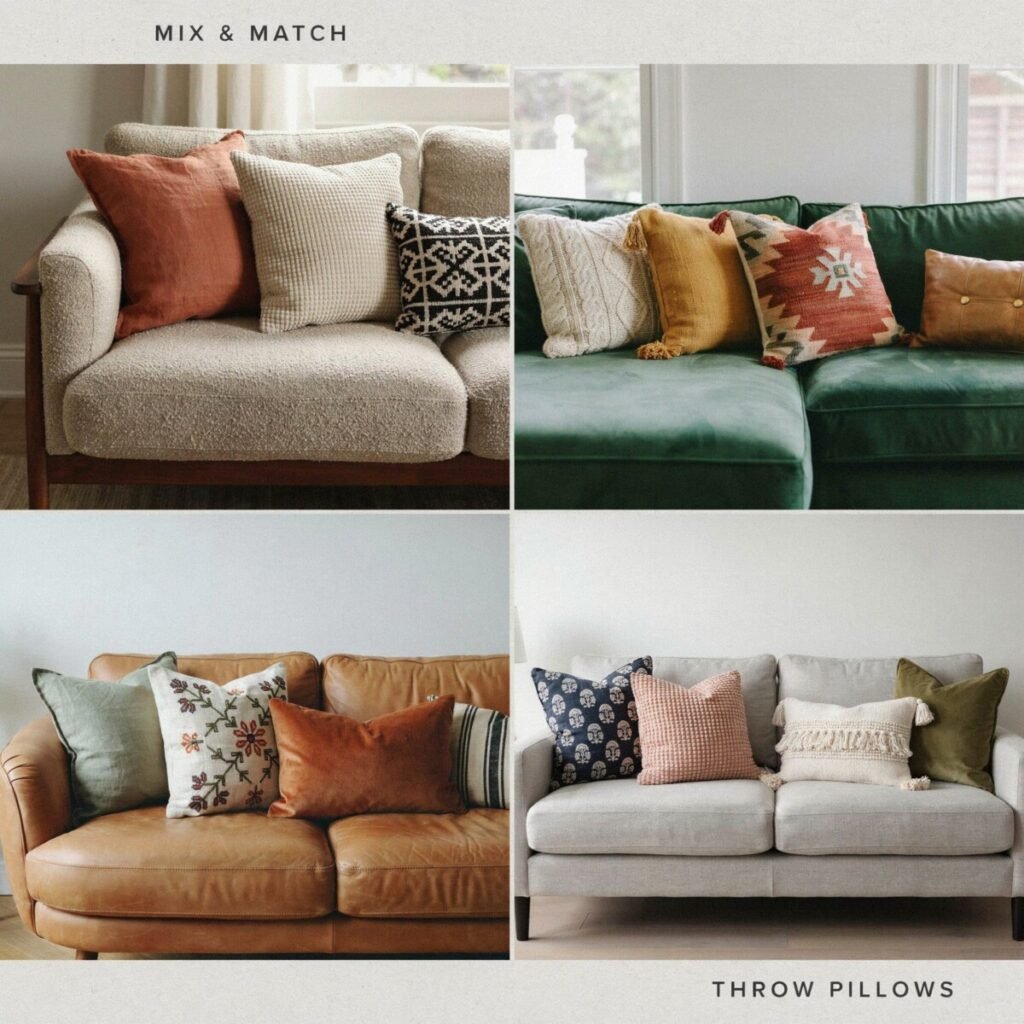
Why Mixing and Matching Throw Pillows Works
You’ve probably seen those perfectly matched pillow sets sold in packs of two. They’re fine—but they’re not interesting. The reason a designer throw pillow arrangement looks so polished is that it layers visual depth, texture, and color in a way that feels curated, not cookie-cutter.
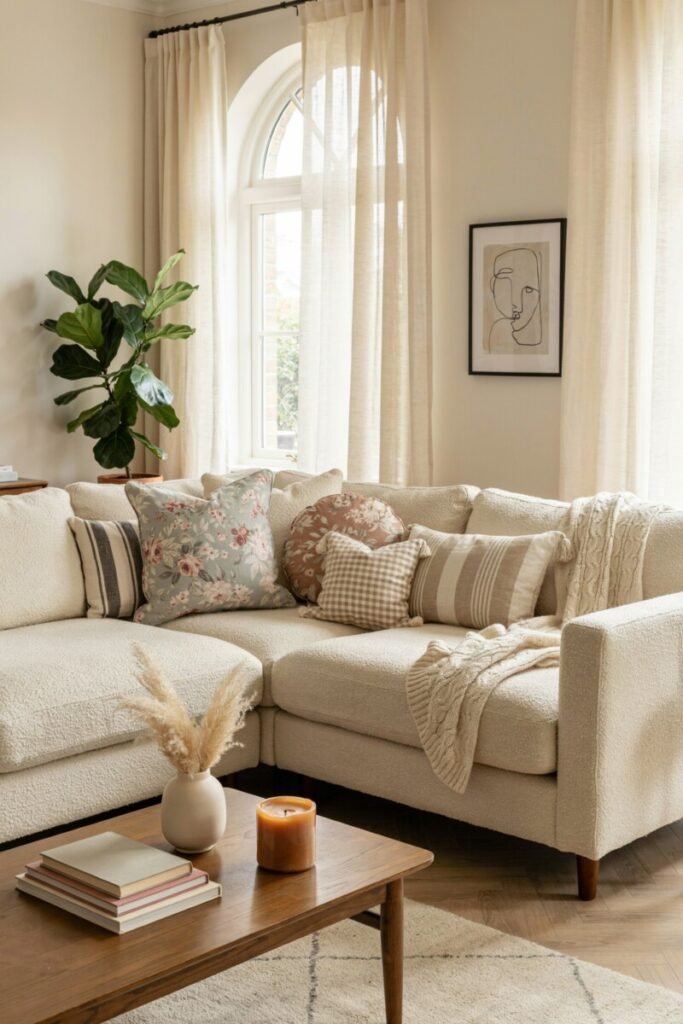
When you mix throw pillows of different sizes, patterns, and textures, you create:
- Visual depth. Layered throw pillows at varying heights and angles make a flat sofa look three-dimensional and inviting.
- Color storytelling. Pulling two or three hues from your rug, curtains, or wall art ties the whole room together without requiring a full redecorate.
- Personality. A mix of patterns and textures reads as intentional and collected-over-time, rather than bought-off-a-single-shelf.
Think of it this way: matching sets say “I bought this at a store.” A curated mix says “I designed this room.” That small shift is what elevates your living room styling from okay to oh wow.
Step 1: Choose Your Base Color Palette
Before you buy a single pillow cover, look around your living room. Your color palette is already hiding in plain sight.
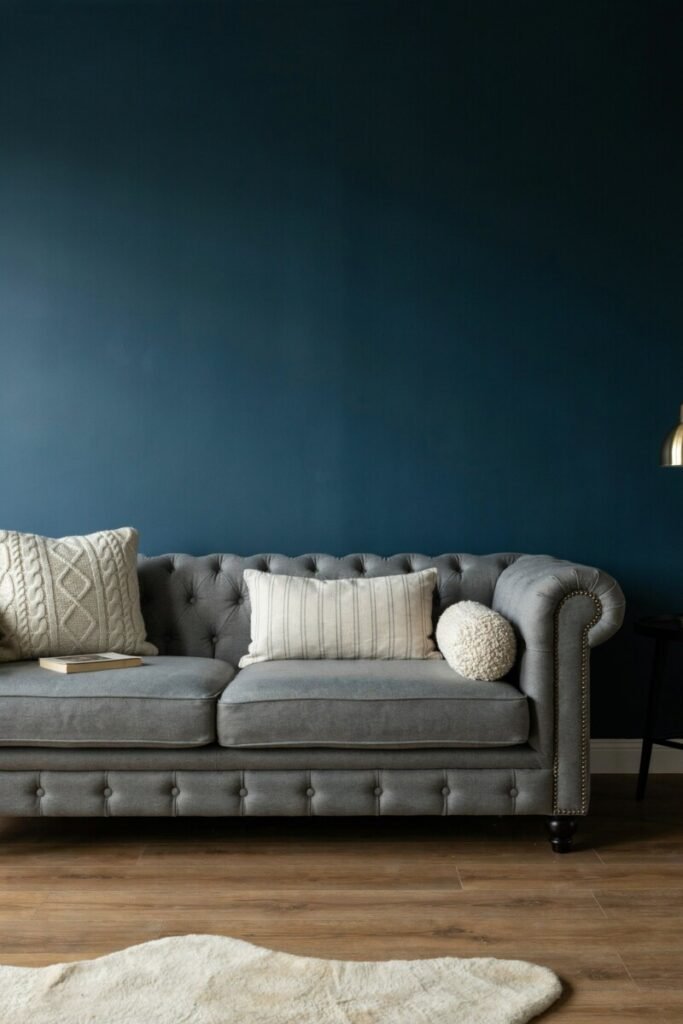
Pull colors from what you already own:
- Your sofa’s upholstery color
- The dominant hue in your area rug
- Wall paint or wallpaper
- Artwork above or near the couch
- A throw blanket draped over the arm
The simple three-color rule:
- One dominant neutral (cream, gray, tan, white)
- One secondary color (blue, sage green, terracotta, mustard)
- One accent pop (rust, coral, gold, deep teal)
This gives your throw pillow color combinations cohesion without looking monotone.
Quick Color Recipes by Sofa Color
- Gray sofa: Charcoal + soft blue + cream with a chunky knit texture
- Beige/cream sofa: Warm taupe + dusty rose or sage + ivory linen
- Navy sofa: Cream + gold/mustard + one white geometric pattern
- Brown/leather sofa: Rust + cream + forest green or burnt orange
- White sofa: Black + gray + one bold accent (coral, cobalt, emerald)
Pro tip: Grab paint swatches or hold fabric samples next to your sofa in natural daylight. Colors look dramatically different under warm indoor lighting versus sunlight.
Mini Color Guide
- Complementary: Opposite colors on the wheel for contrast (blue + orange, teal + coral). Great for one accent pillow against neutrals.
- Analogous: Neighboring colors for harmony (blue + teal + green). Feels calm and cohesive.
- Monochromatic: Different shades of one color (light blue, steel blue, navy). Sophisticated and low-risk.
If you’re searching for the best pillow colors for a gray couch or accent pillows for your living room, start with this framework and you can’t go wrong.
Step 2: Pick the Right Sizes and Shapes
Size variety is what separates a flat, boring pillow lineup from a full, designer-looking arrangement. Here’s your cheat sheet for throw pillow sizes common in the US market:
- 22×22″ or 24×24″ – Large squares (anchor pillows, go in back corners)
- 20×20″ – Medium squares (middle layer)
- 18×18″ – Standard squares (front layer or smaller sofas)
- Lumbar: 12×20″ or 14×22″ – Rectangular (center accent, adds shape variety)
- Bolster or round – Optional accent for extra dimension
Rule of thumb: Use at least 2–3 different sizes. If every pillow is the same dimension, the arrangement looks stiff.
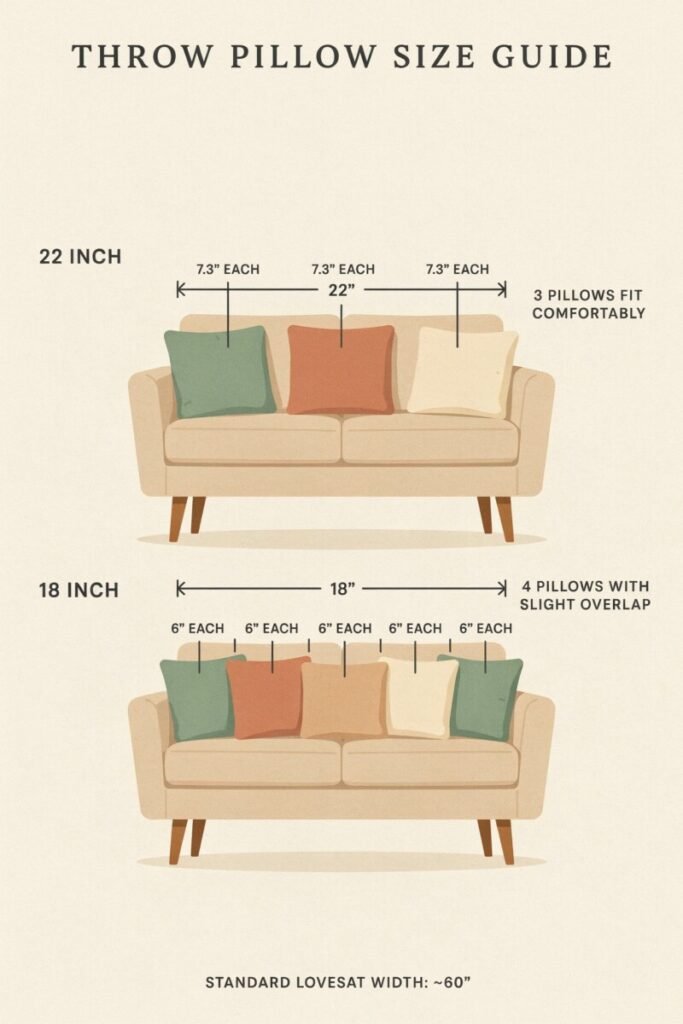
Sizing by Couch Type
- Loveseat / small apartment sofa: 2–3 pillows max. One 20″, one 18″, optional small lumbar.
- Standard 3-seater sofa: 4–5 pillows. Two 22″ in back corners, two 18–20″ in front, one lumbar in center.
- Large sectional: 5–7 pillows total across sections. Largest in outer corners, smaller toward the center.
Pro tip: Always size up your insert by 2 inches. A 22″ cover stuffed with a 24″ insert gives that plump, high-end look. A flat, under-stuffed pillow reads cheap no matter how pretty the fabric.
Ready-to-Copy Formulas
Standard sofa formula: 2× 22″ squares (corners) + 2× 20″ squares (front) + 1× 14×22″ lumbar (center)
Sectional formula: Treat each section as its own zone—2 to 3 pillows per section, largest in corners, tapering smaller toward the middle. Leave at least one seat relatively clear for actual sitting.
If you’ve ever wondered how many throw pillows on a couch is “right,” the answer is: enough to look full, few enough that guests can still sit down comfortably.
Step 3: Mix Patterns and Textures Like a Pro
This is where most people get nervous, but mixing patterns with throw pillows follows a surprisingly simple formula.
The golden pattern rule:
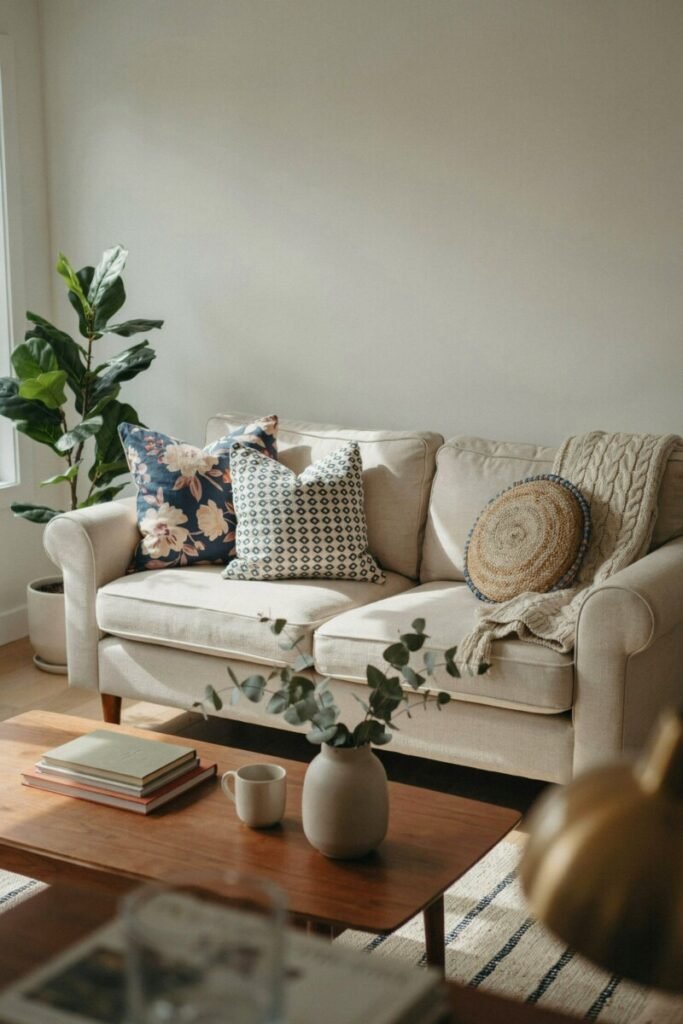
- 1 large-scale pattern – Big florals, bold geometrics, oversized stripes
- 1 small/medium pattern – Thin stripes, tiny dots, subtle tone-on-tone prints
- 1–2 textured solids – Linen, boucle, velvet, chunky knit, faux fur
Keeping a shared color thread across all three ties them together. A navy-and-cream stripe, a navy-and-cream floral, and a solid navy velvet pillow all “speak” to each other because navy and cream repeat throughout.
Designer Formulas to Steal
- Formula A: 1 solid + 1 busy pattern + 1 simple pattern (classic, balanced)
- Formula B: 2 colorful pillows + 1 neutral textured pillow (lets color shine without overwhelm)
- The 60-30-10 rule: 60% solid/texture, 30% mid-scale pattern, 10% bold statement pattern
Texture Ideas That Add Instant Depth
- Chunky cable knit (cozy, farmhouse)
- Velvet (modern, glam)
- Natural linen (airy, coastal, Scandinavian)
- Embroidered or woven details (boho, global)
- Faux fur or shearling (winter refresh)
When to go bold vs. keep it calm: If your rug, curtains, or artwork are already busy, lean toward textured solids and one subtle pattern. If the room is quiet and neutral, that’s your green light for a statement floral or geometric.
Step 4: Arrange Pillows on Different Couch Types
Knowing how to arrange throw pillows on a couch depends heavily on the couch itself. Here’s your arrangement blueprint.
Standard 3-Seater Sofa
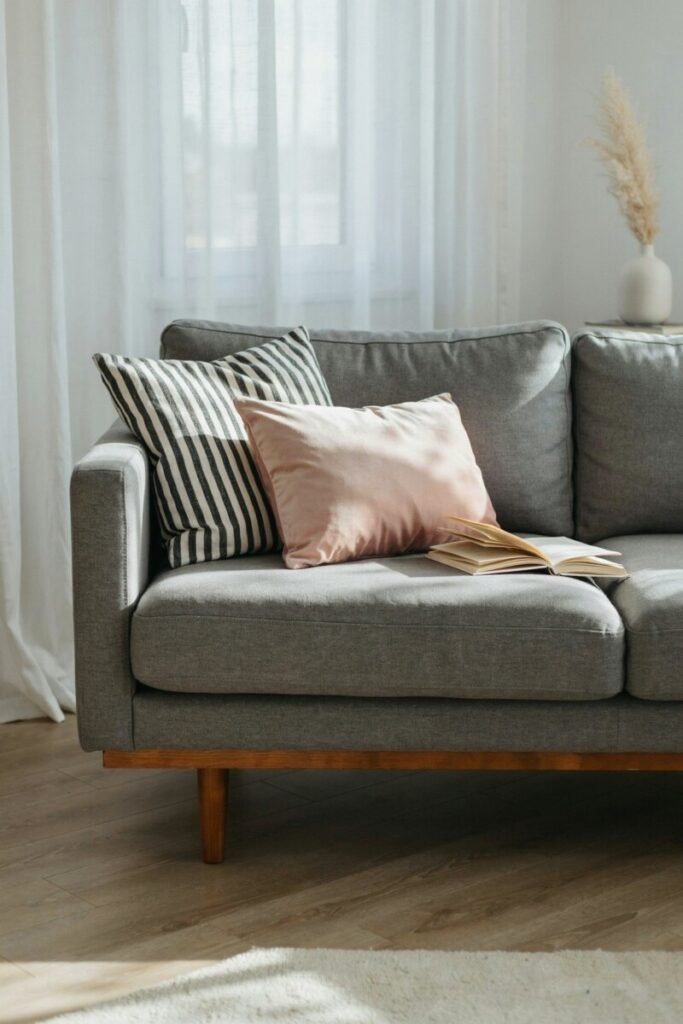
- Symmetrical look: Two 22″ pillows in back corners, two 20″ pillows overlapping in front, one lumbar centered. Clean and polished.
- Asymmetrical look: Stack three pillows on the left (22″ + 20″ + 18″), place two on the right (22″ + lumbar). Feels relaxed and lived-in.
Loveseat / Small Apartment Sofa
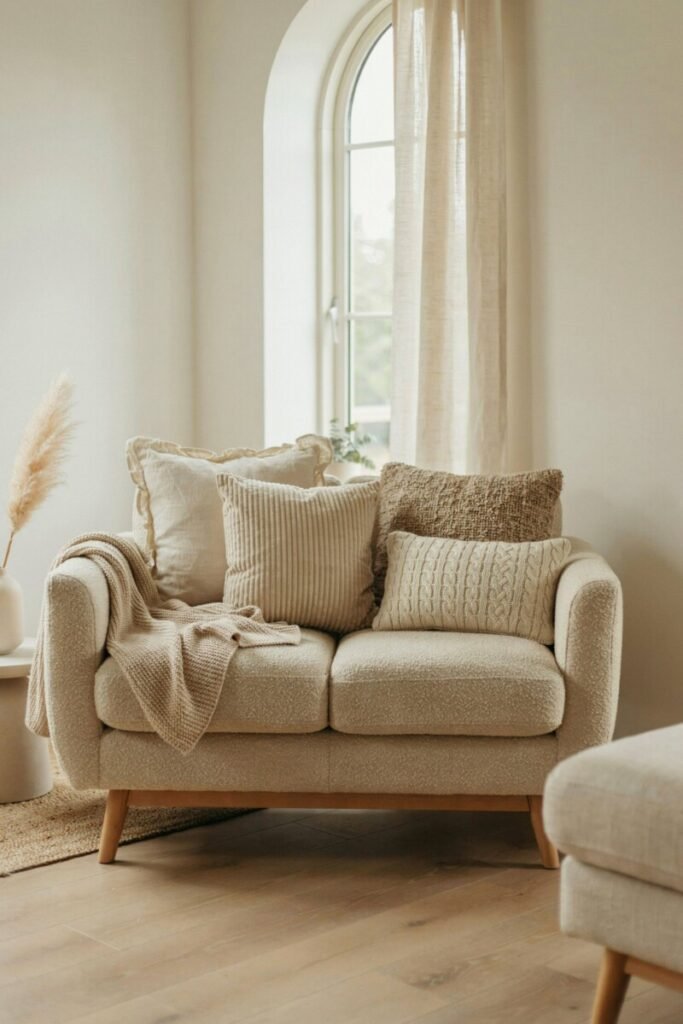
Keep it to 2–3 pillows total. One 20″ square, one 18″ square, and optionally a slim lumbar. Overcrowding a small sofa makes the whole room feel cramped.
Sectional Sofa
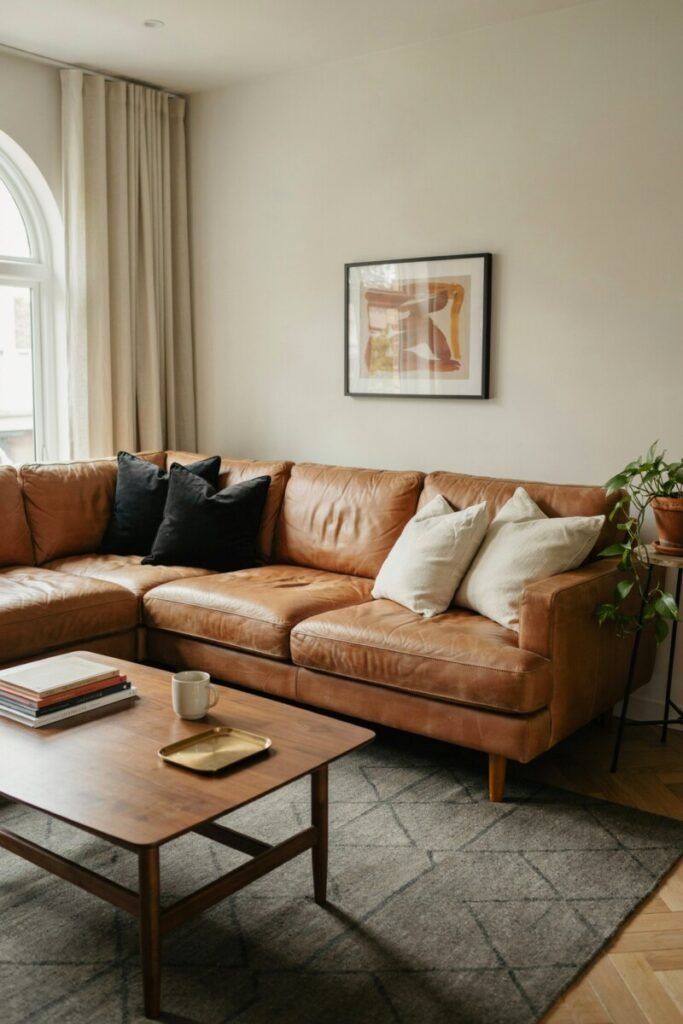
Treat each section as its own styling zone:
- Largest pillows (22–24″) anchor the outer corners
- Medium pillows (18–20″) fill the middle
- One lumbar or accent pillow bridges the corner joint
- Leave at least one seating area relatively pillow-free so people can actually sit
This sectional throw pillow layout keeps things balanced without turning the couch into a pillow fortress.
Sleeper Sofa / Multi-Use Couch
Prioritize easy removal. Stick to 2–3 lighter pillows: one statement piece, one or two neutrals. Avoid heavy inserts that are annoying to stash when guests pull out the bed.
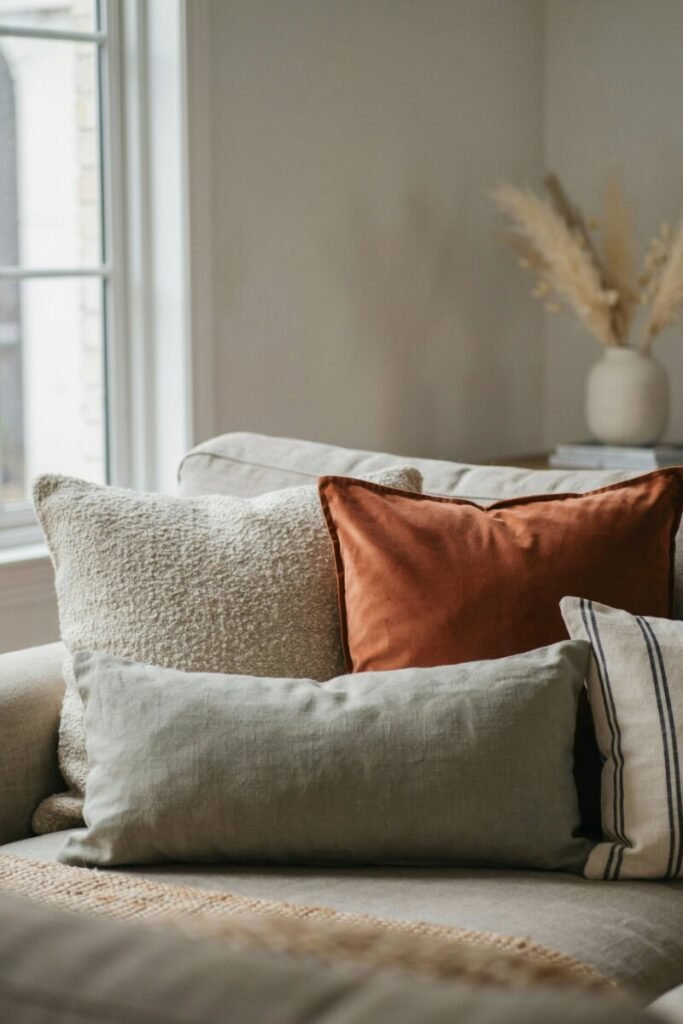
Quick Do’s and Don’ts
Do:
- Vary sizes and shapes
- Repeat 1–2 colors from elsewhere in the room
- Leave breathing room on the seat
Don’t:
- Cover every inch of the couch
- Use only tiny 16″ pillows on a large sofa (they vanish)
- Ignore comfort—guests need somewhere to sit
Color Guides: Specific Sofa Color Scenarios
Use these as a starting point, then personalize.
Gray Couch
- Dominant: Charcoal + cream
- Accent: Soft blue or dusty teal
- Pattern/texture: One geometric print in blue/gray; one chunky knit in cream
- Vibe: Modern, clean, slightly coastal
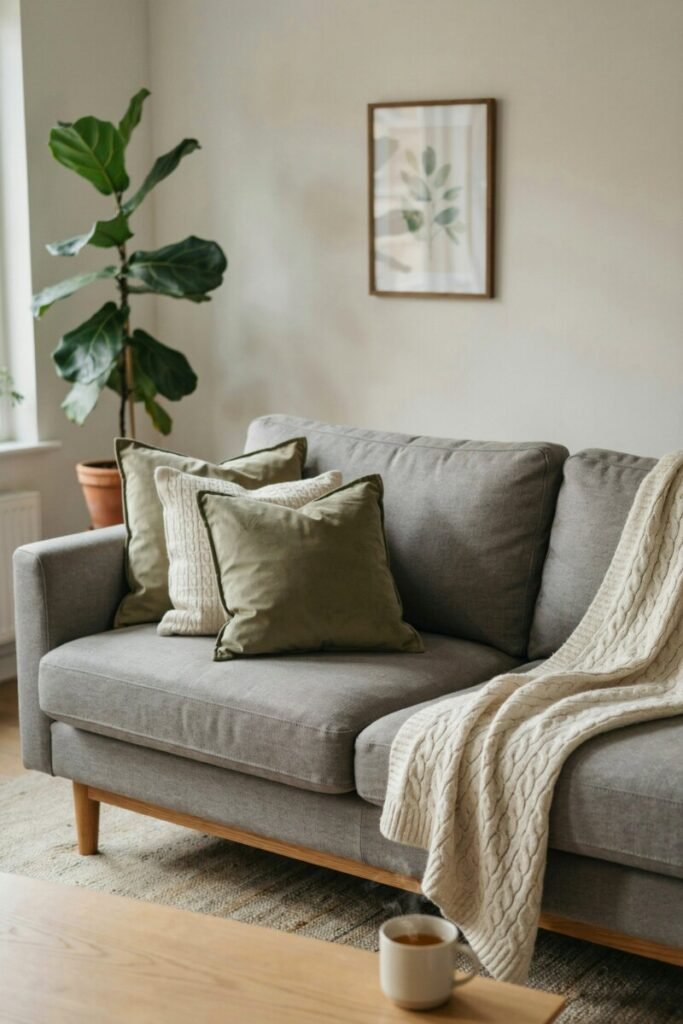
Beige / Cream / Off-White Couch
- Dominant: Warm taupe + ivory
- Accent: Sage green, terracotta, or muted rust
- Pattern/texture: Subtle botanical print; woven linen texture
- Vibe: Organic modern, farmhouse, or warm minimalist
Navy or Dark Blue Couch
- Dominant: Cream + white
- Accent: Mustard gold or coral
- Pattern/texture: One white-and-navy stripe; one gold velvet solid
- Vibe: Preppy, coastal, or mid-century modern
Brown or Leather Couch
- Dominant: Cream + rust/burnt orange
- Accent: Forest green or deep burgundy
- Pattern/texture: Aztec or tribal weave; chunky knit in cream
- Vibe: Warm boho, Southwestern, or rustic farmhouse
Black or Charcoal Couch
- Dominant: White + light gray
- Accent: Camel/tan or a single bold pop (emerald, fuchsia)
- Pattern/texture: Black-and-white geometric; smooth velvet
- Vibe: Sleek modern, art deco, or industrial chic
White Couch (High-Contrast Look)
- Dominant: Black + medium gray
- Accent: Cobalt blue, emerald, or warm terracotta
- Pattern/texture: Bold graphic print; nubby boucle in a neutral
- Vibe: Contemporary, gallery-like, or bold eclectic
Common Mistakes to Avoid
Even with the best intentions, a few missteps can undo your whole arrangement. Here are the most common sofa styling errors—and how to fix them fast:
- All one size. Five identical 18×18 pillows look flat. Fix: Swap two for 22″ and add a lumbar.
- Too-tiny pillows on a big sofa. They disappear. Fix: Scale up to at least 20–22″ for anchor pillows.
- Matching sets with zero variation. Fix: Keep one color consistent but change the pattern, texture, or shape.
- Ignoring the room’s palette. Pillows that clash with your rug or walls feel random. Fix: Pull one color directly from an existing element.
- Overstuffing the couch. If guests have to toss pillows on the floor, you’ve gone too far. Fix: Remove one or two and prioritize seating space.
- Clashing undertones. Cool gray pillows against a warm beige rug can feel “off.” Fix: Match warm with warm, cool with cool.
Budget-Friendly Tips & Where to Shop (US Focus)
You don’t need a designer budget for a designer look. Here’s how to pull off layered throw pillows without overspending:
Know how many you actually need. A standard sofa needs 4–5 pillows. A loveseat needs 2–3. A sectional needs 5–7. Write the number down before you shop so you don’t overbuy.
Mix high and low. Invest in one or two statement pillows (handwoven, embroidered, or high-quality velvet) and fill the rest with affordable basics in solid colors.
Where to shop in the US:
- Target, Walmart – Great for $10–$20 solid and simple patterned pillows
- HomeGoods, TJ Maxx, Marshalls – Treasure-hunt territory for unique textures and one-offs at 30–50% off retail
- Amazon, Wayfair – Huge selection of affordable throw pillow covers (search by size and color)
- Etsy – Handmade, small-batch covers for a truly unique look
Pro tip: Buy covers, not full pillows, whenever possible. You can swap seasonal colors for under $10 per cover, stuff them into inserts you already own, and store off-season covers flat in a closet. It’s the easiest living room refresh you’ll ever do.
Quick Recap: Your Throw Pillow Styling Checklist
Screenshot this for your next Target run or Amazon scroll:
- ✅ Pick 2–3 colors pulled from your existing room (sofa, rug, art)
- ✅ Choose 2–3 pillow sizes, including at least one lumbar
- ✅ Mix 1 large-scale pattern + 1 small pattern + 1–2 textured solids
- ✅ Keep a shared color thread across all pillows
- ✅ Arrange largest pillows in back corners, smaller ones in front
- ✅ Adjust count and layout for your couch type (sofa, sectional, loveseat)
- ✅ Leave room to actually sit
- ✅ Size up inserts by 2″ for a plump, designer finish
That’s it. No design degree required—just a few intentional choices. Grab your color palette, pick your sizes, mix those patterns, and give your couch the glow-up it deserves. Your living room will thank you.
