
You stare at your kitchen every morning and the same thought creeps in: these cabinets have got to go. But a full kitchen renovation can cost tens of thousands of dollars and take months. The good news? A kitchen cabinet makeover is one of the highest-impact home updates you can tackle, and you’ve got three realistic paths — painting, replacing, or refacing — each with very different price tags, timelines, and results. Let’s break them down so you can pick the one that fits your budget, your schedule, and your sanity.
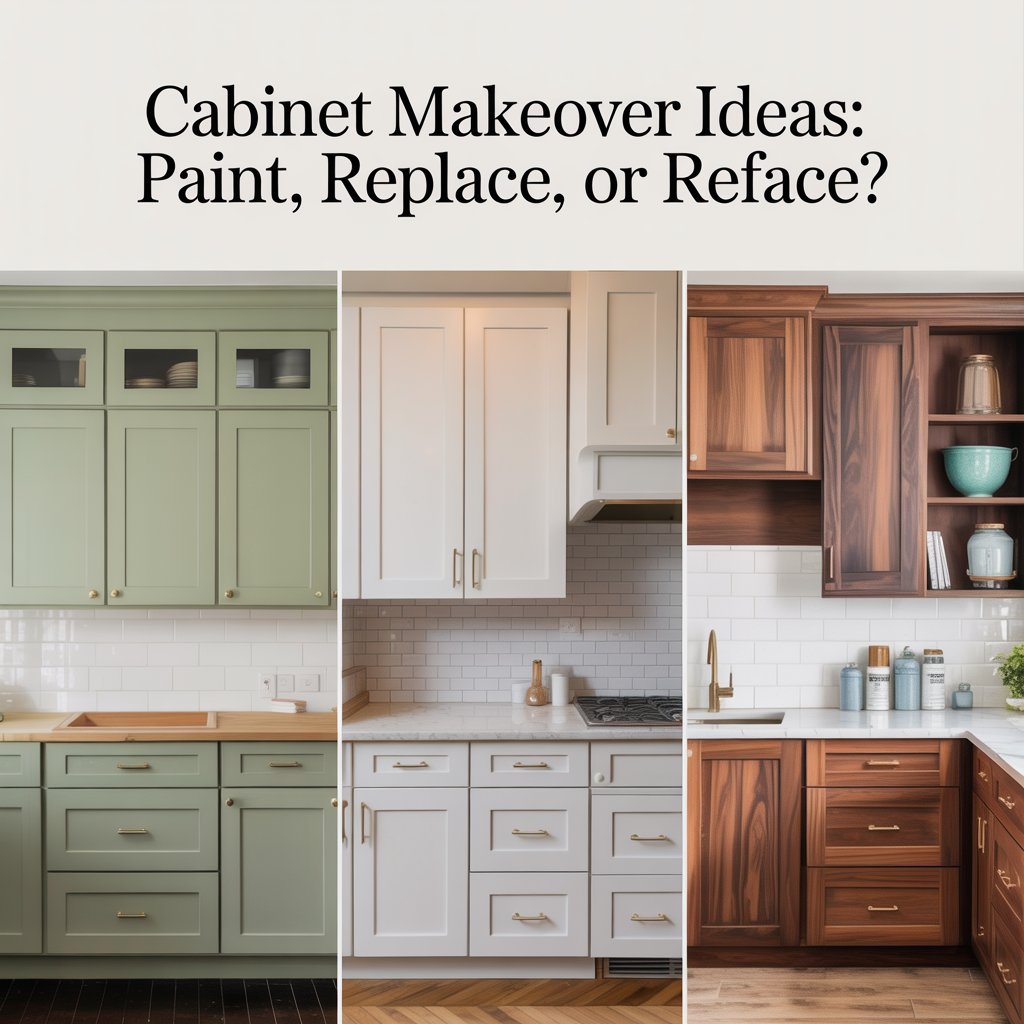
Quick Overview: What Are Your Three Options?
Painting your cabinets is exactly what it sounds like: stripping, priming, and applying fresh paint to your existing cabinet boxes and doors. It’s the most budget-friendly cosmetic refresh and the go-to for homeowners who want a quick visual upgrade without changing the layout.
Replacing your cabinets means tearing out the old ones entirely and installing brand-new boxes, doors, and drawers. This is the most expensive and disruptive option, but it gives you total freedom over materials, layout, storage solutions, and design.
Refacing your cabinets sits right in the middle. You keep the existing cabinet boxes (the “bones”) but replace the doors and drawer fronts and cover the exposed box surfaces with a matching veneer or laminate. You get a nearly-new look at roughly half the cost of full replacement.
Each approach has a sweet spot, and the right choice depends on the condition of your current cabinets, how long you plan to stay in your home, and what you’re willing to spend.
Option 1: Paint Your Cabinets
🔑 Key Takeaway — Best for a cosmetic refresh under ~$3,000 when cabinet boxes are structurally sound.
Typical cost: \$1,500–\$3,500 (professional) · \$200–\$600 (DIY) · Timeline: 3–7 days
Scope and Process
A proper cabinet refinish with paint goes well beyond rolling a coat of wall paint onto doors. Professionals typically remove every door and drawer front, degrease surfaces with TSP (trisodium phosphate), sand or degloss, apply a bonding primer, and then spray or brush two to three topcoats of a hard, cabinet-grade finish. Homeowners can choose between water-based acrylic enamel (low odor, fast dry, increasingly durable), traditional oil-based alkyd enamel (rock-hard cure, longer dry time, stronger fumes), or hybrid formulas that combine the best of both.
Whether you paint cabinets yourself or hire a pro, expect at least two full days of prep before a single drop of paint hits the surface. Skipping prep is the number-one reason DIY paint jobs chip and peel within a year.
Durability and Lifespan
Painted kitchen cabinets typically last 5–10 years before showing noticeable wear around handles, edges, and high-touch areas. Oil-based and hybrid finishes tend to hold up longer than straight latex. Expect to do a light touch-up or full repaint roughly every decade.
Color and Design Trends
For 2026, kitchen cabinet trends continue to favor warm whites (think Benjamin Moore White Dove or Sherwin-Williams Alabaster), sage greens, navy blues, and warm wood-tone stains on island cabinets for a two-tone look. Matte and satin sheens are edging out high-gloss in most US markets.
Cost Breakdown (US Market, 2026)
| Scope | Approximate Cost |
|---|---|
| DIY materials only (paint, primer, supplies) | \$200–\$600 |
| Professional painting (average US kitchen, 25–30 linear ft) | \$2,000–\$4,500 |
| High-end professional spray finish | \$4,500–\$7,000+ |
Pros and Cons of Painting Cabinets
Pros:
- Lowest cost of all three options
- Fastest turnaround — often under a week
- Massive color flexibility; easy to change later
- Minimal waste and disruption
- Great for renters, flippers, or budget-conscious homeowners planning a full remodel in a few years
Cons:
- Doesn’t fix structural issues, poor layouts, or damaged boxes
- Paint can chip, scratch, or yellow over time
- Grain from oak or open-pore woods can show through unless filled
- Resale value boost is modest compared to replacement
Ideal Candidates
Painting is the smartest move when your cabinet boxes are solid, the layout works, and you just want a fresh look on a tight timeline — or when you’re staging a home for sale and need maximum visual impact for minimum spend.
Option 2: Replace Your Cabinets
🔑 Key Takeaway — Best when you want a new layout, updated storage, or your existing boxes are damaged beyond cosmetic repair.
Typical cost: \$5,000–\$25,000+ · Timeline: 3–8 weeks (order to install)
Scope and Process
A full cabinet replacement cost varies enormously depending on whether you choose stock, semi-custom, or custom cabinetry. Stock cabinets are pre-built in standard sizes and ship in days — expect \$75–\$250 per linear foot installed. Semi-custom cabinets let you tweak dimensions, door styles, finishes, and interior organizers — roughly \$150–\$450 per linear foot installed. True custom cabinets are built from scratch by a cabinetmaker and can run \$500–\$1,500+ per linear foot.
Material matters just as much as construction type. Solid-wood doors are premium but can expand and contract with humidity. Plywood boxes are the gold standard for strength and moisture resistance. MDF (medium-density fiberboard) is budget-friendly and paints beautifully but swells if exposed to water. Particleboard is the cheapest and least durable option — generally avoid it for any kitchen where moisture is a factor.
Installation Complexity
Replacing cabinets is a multi-trade project. You’ll likely need demolition, possible plumbing and electrical rough-in adjustments, drywall repair, new cabinets, countertops, and possibly a new backsplash. A general contractor typically manages the flow, and the whole process from order to final punch-list usually spans 4–8 weeks for semi-custom cabinets, since lead times from manufacturers have normalized to roughly 3–5 weeks in 2026.
Durability and Lifespan
Quality semi-custom cabinets with plywood boxes and solid-wood or high-grade MDF doors can last 20–50 years with proper care. The cabinet lifespan you get is directly tied to material quality, hardware (soft-close hinges and full-extension drawer slides make a huge difference), and how well the installation was leveled and secured.
Cost Breakdown (US Market, 2026)
| Tier | Approximate Installed Cost (Avg. US Kitchen) |
|---|---|
| Stock cabinets | \$5,000–\$10,000 |
| Semi-custom cabinets | \$10,000–\$22,000 |
| Custom cabinets | \$22,000–\$50,000+ |
Pros and Cons of Replacing Cabinets
Pros:
- Complete design freedom — new layout, new storage, new everything
- Highest resale value return (typically 75–85% of cost recouped at sale, per Remodeling Magazine’s Cost vs. Value data)
- Longest lifespan of all three options
- Opportunity to add modern conveniences: pull-out trash, spice racks, deep drawers, soft-close everything
- Fixes structural, water damage, or pest issues that paint or refacing can’t
Cons:
- Most expensive option by a wide margin
- Most disruptive — kitchen is out of commission for weeks
- Generates significant demolition waste
- Longer timeline due to ordering and installation
Ideal Candidates
Full replacement makes sense when your cabinets are damaged, you want to reconfigure the layout (add an island, move the sink), you’re planning to stay in the home for 10+ years, or the kitchen is a central selling point and you want maximum ROI.
Option 3: Reface Your Cabinets
🔑 Key Takeaway — Best when cabinet boxes are structurally sound but you want a near-new look at roughly half the cost of replacement.
Typical cost: \$4,000–\$10,000 · Timeline: 3–5 days of active work
Scope and Process
Refacing cabinets (sometimes called cabinet resurfacing) means keeping your existing cabinet boxes in place but replacing all doors and drawer fronts with new ones and covering the visible exterior surfaces of the boxes with a matching veneer, thermofoil, or rigid laminate. It’s essentially a cabinet door replacement combined with a surface skin.
A professional refacing crew will remove old doors and hardware, sand and prep box surfaces, apply adhesive-backed veneer or laminate to exposed faces, hang new doors with new hinges, install new drawer fronts, and typically include a cabinet hardware upgrade with new pulls and knobs. The existing interior of your cabinets stays untouched.
Materials Used in Refacing
- Wood veneer — real wood sliced thin and applied over boxes; can be stained or painted; most premium look
- Thermofoil — vinyl film thermoformed over MDF; seamless, moisture-resistant, limited color options
- Rigid thermofoil (RTF) or laminate — durable, scratch-resistant, wide range of colors and patterns
- Solid wood doors — often paired with veneered boxes for a high-end result
Durability and Lifespan
Properly done, refaced cabinets can last 15–25 years. The new doors and veneer are essentially the same materials you’d get with new cabinets — the difference is that the underlying box structure is older. If your boxes were well-built to begin with, refacing can give you decades more life.
Cost Breakdown (US Market, 2026)
| Scope | Approximate Cost |
|---|---|
| Basic refacing (laminate/thermofoil, average kitchen) | \$4,000–\$7,000 |
| Mid-range refacing (wood veneer, new hardware) | \$7,000–\$10,000 |
| High-end refacing (custom doors, premium finishes) | \$10,000–\$15,000 |
Pros and Cons of Refacing Cabinets
Pros:
- Roughly 40–60% of the cost of full replacement
- Much faster — most projects wrap in under a week
- Kitchen stays usable during the project (you can cook most nights)
- Far less waste than full demo — eco-friendlier option
- Wide range of door styles and finishes available
- Strong visual transformation for the investment
Cons:
- Does not change layout or fix structural box problems
- Interior of cabinets remains as-is (old shelving, old drawer boxes)
- If boxes are water-damaged, warped, or poorly built, refacing is throwing good money after bad
- Limited ability to add specialty storage inserts compared to new cabinets
- Some refacing companies use lower-grade materials — vetting contractors is critical
Ideal Candidates
Refacing vs replacing cabinets comes down to one question: are the boxes sound? If yes, and you’re happy with the current layout, refacing is the sweet spot between cost and impact. It’s especially smart for homeowners planning to stay 5–15 years, those who want a major visual upgrade without the chaos of a full kitchen demolition, or anyone conscious about reducing renovation waste.
Head-to-Head Comparison
Here’s the quick-glance breakdown of cabinet painting vs refacing vs. full replacement:
| Factor | Paint | Reface | Replace |
|---|---|---|---|
| Typical cost (avg. US kitchen) | \$2,000–\$4,500 | \$4,000–\$10,000 | \$10,000–\$30,000+ |
| Timeline | 3–7 days | 3–5 days | 4–8 weeks |
| Layout changes | None | None | Full flexibility |
| Structural fixes | None | None | Yes |
| Durability/lifespan | 5–10 years | 15–25 years | 20–50 years |
| Resale value boost | Low–Moderate | Moderate | High |
| Waste/environmental impact | Very Low | Low | High |
| Customization | Color only | Doors + finishes | Unlimited |
Simple rules of thumb:
Paint if your budget is under \$3,000, you need a cosmetic refresh, and the boxes are fine.
Reface if the boxes are solid but dated, you want new doors and a near-new look, and you don’t need layout changes.
Replace if you’re changing the layout, boxes are damaged, or you want maximum longevity and resale value.
Decision Checklist: Which Option Is Right for You?
Work through these questions to narrow your choice:
- What’s your budget? Under \$4K → likely paint. \$4K–\$10K → reface or stock replacement. \$10K+ → semi-custom replacement or premium refacing.
- Are the cabinet boxes structurally sound? If warped, water-damaged, or infested → replacement is the only real answer.
- Do you want to change the kitchen layout? Any layout change → replace. Same layout → paint or reface.
- How long do you plan to stay? Selling in 1–3 years → paint for staging. Staying 5–15 years → reface or replace depending on budget. Staying 15+ years → invest in quality replacement.
- How much disruption can you tolerate? Need the kitchen functional during the project → reface or paint. Can survive without a kitchen for a month → replace.
- Is environmental impact a priority? Painting and refacing generate dramatically less waste than full replacement.
- What’s the condition of the doors and drawer fronts? If they’re dented, warped, or the style screams 1987 → refacing or replacement. If just discolored → paint.
Mini Case Study
Jenna in Austin had structurally sound 1990s oak cabinet boxes but scuffed, outdated raised-panel doors. On a \$2,200 budget, she chose professional refacing — new Shaker-style doors with a white thermofoil finish plus matching veneer on the box faces — for roughly \$1,900 and splurged \$300 on a cabinet hardware upgrade with matte black bar pulls. The project took two weeks from consultation to completion (only three days of active on-site work). Result: a modern, bright kitchen that boosted her home’s resale appeal with far less waste than a full gut.
DIY vs. Professional: When to Go It Alone
DIY cabinet makeover with paint is genuinely achievable for a patient homeowner with basic tools — a quality sprayer (or high-density foam rollers), a well-ventilated workspace, and the discipline to prep thoroughly. Expect to spend 5–10 full days if it’s your first time. The biggest pitfalls are insufficient degreasing (kitchen grease is the enemy of paint adhesion), skipping primer, and rushing between coats.
Refacing and replacement are almost always best left to professionals. Refacing requires precision veneer application, door alignment, and hinge adjustment that takes years to master. Full replacement involves plumbing, electrical, and finish carpentry that most homeowners shouldn’t tackle without significant experience. Budget for a licensed, insured contractor with strong reviews and ask for a portfolio of completed kitchen cabinet makeover projects.
Cost-Saving Tips Without Sacrificing Quality
- Keep the existing layout — moving plumbing, gas, and electrical is where kitchen renovation cost skyrockets.
- Paint instead of replacing if boxes are sound — a professional spray finish in a trending neutral can rival the look of new cabinets.
- Choose semi-custom over full custom — you get 90% of the design flexibility at 50–60% of the cost.
- Upgrade hardware yourself — a cabinet hardware upgrade with modern pulls and knobs can cost \$150–\$400 and completely change the look, even on existing cabinets.
- Refinish or reface just the doors — some cabinet shops will build new doors to fit your existing boxes at a fraction of a full reface.
- Time your project around sales — big-box stores and cabinet suppliers typically run their best promotions around Presidents’ Day, Memorial Day, Labor Day, and Black Friday.
- Mix open shelving with cabinets — removing upper cabinets on one wall and installing floating shelves cuts material costs and feels contemporary.
- Do demolition yourself (if replacing) — demo is labor-intensive but doesn’t require specialized skills, and you can save \$500–\$1,500 on labor.
Design Inspiration and Current Trends
The 2026 kitchen cabinet trends lean toward warm, nature-inspired palettes. Two-tone kitchens remain popular — try a bold color (deep forest green, navy, or warm terracotta) on the island with soft white or cream on the perimeter cabinets. Matte black and brushed brass hardware continue to dominate. For a high-end look on a budget, combine painted uppers with natural wood-tone lowers, or add a section of open shelving styled with ceramics and cookbook displays. Small upgrades that amplify any cabinet makeover ideas project include under-cabinet LED lighting, a fresh backsplash in zellige tile or large-format slab, and integrated charging stations inside a drawer.
Maintenance and Longevity Tips
No matter which option you choose, care extends life. For painted kitchen cabinets, wipe spills immediately (especially around the sink and stove), use cabinet door bumpers to prevent chip-causing slams, and keep a small jar of touch-up paint handy. For refaced surfaces, avoid abrasive cleaners — a damp microfiber cloth with mild dish soap is all you need. For new cabinets, lubricate soft-close hinges annually, check drawer slide alignment if drawers start to stick, and keep humidity in the kitchen between 35–50% to minimize wood expansion and contraction.
Your Next Steps
Choosing between painting, refacing, and replacing your cabinets ultimately comes down to your budget, your timeline, and how long you plan to enjoy the result. Start by opening a cabinet door and inspecting the boxes — are they sturdy, level, and free of water damage? Get at least three quotes from local professionals for whichever option you’re leaning toward, and always test paint samples on a hidden surface before committing to a color. Whichever path you choose, a refreshed kitchen is one of the most satisfying home improvements you can make. Have questions or want to share your own kitchen remodel on a budget story? Drop a comment below — we’d love to hear how your project turned out.
Frequently Asked Questions
1. Is it cheaper to paint or reface kitchen cabinets?
Painting is almost always cheaper. A professional paint job typically runs \$2,000–\$4,500, while refacing starts around \$4,000 and can reach \$10,000+. However, refacing lasts significantly longer (15–25 years vs. 5–10 for paint), so the cost-per-year of ownership is closer than the upfront numbers suggest.
2. How long do refaced cabinets last compared to new cabinets?
Well-done refaced cabinets can last 15–25 years, while quality new cabinets often last 20–50 years. The difference largely comes down to the age and construction quality of the original cabinet boxes that remain in place after refacing.
3. Can I reface my cabinets if they’re made of particleboard?
It depends on their condition. Particleboard boxes that are dry, level, and free of swelling or sagging can be refaced successfully. However, if there’s any water damage, warping, or screw-stripping, replacement is usually the wiser investment — particleboard doesn’t recover well from damage.
4. Does painting cabinets hurt resale value?
Not if done well. Professionally painted cabinets in a neutral, on-trend color generally improve a home’s appeal to buyers, especially compared to dated or damaged originals. Poor DIY paint jobs with visible brush marks, drips, or peeling, however, can signal deferred maintenance and hurt perceived value.