
Why Your Dream Remodel Costs More Than You Think
Let’s cut to the chase: that dream kitchen remodel just ballooned from $20K to $35K—and you’re not alone. According to the National Kitchen and Bath Association (NKBA), 80% of US renovations exceed budgets by 20-30%, with hidden costs in home renovation acting as silent budget assassins. Whether you’re upgrading a bathroom, gutting a kitchen, or overhauling your entire home, unexpected expenses lurk behind every wall, permit, and paint swatch.
I’ve seen homeowners pour their life savings into a project only to face $10K in surprise structural repairs or $3K for asbestos abatement. These aren’t rare edge cases—they’re the norm. In 2026, with post-pandemic labor shortages and volatile material prices, the stakes are higher than ever.
So, what are these hidden costs in home renovation? From permitting fees that vary wildly by city to plumbing surprises behind vintage walls, we’ll unpack 12 budget killers most contractors won’t warn you about. By the end, you’ll know how to spot them early, budget for the unknown, and turn your remodel dream into reality—without draining your retirement fund.
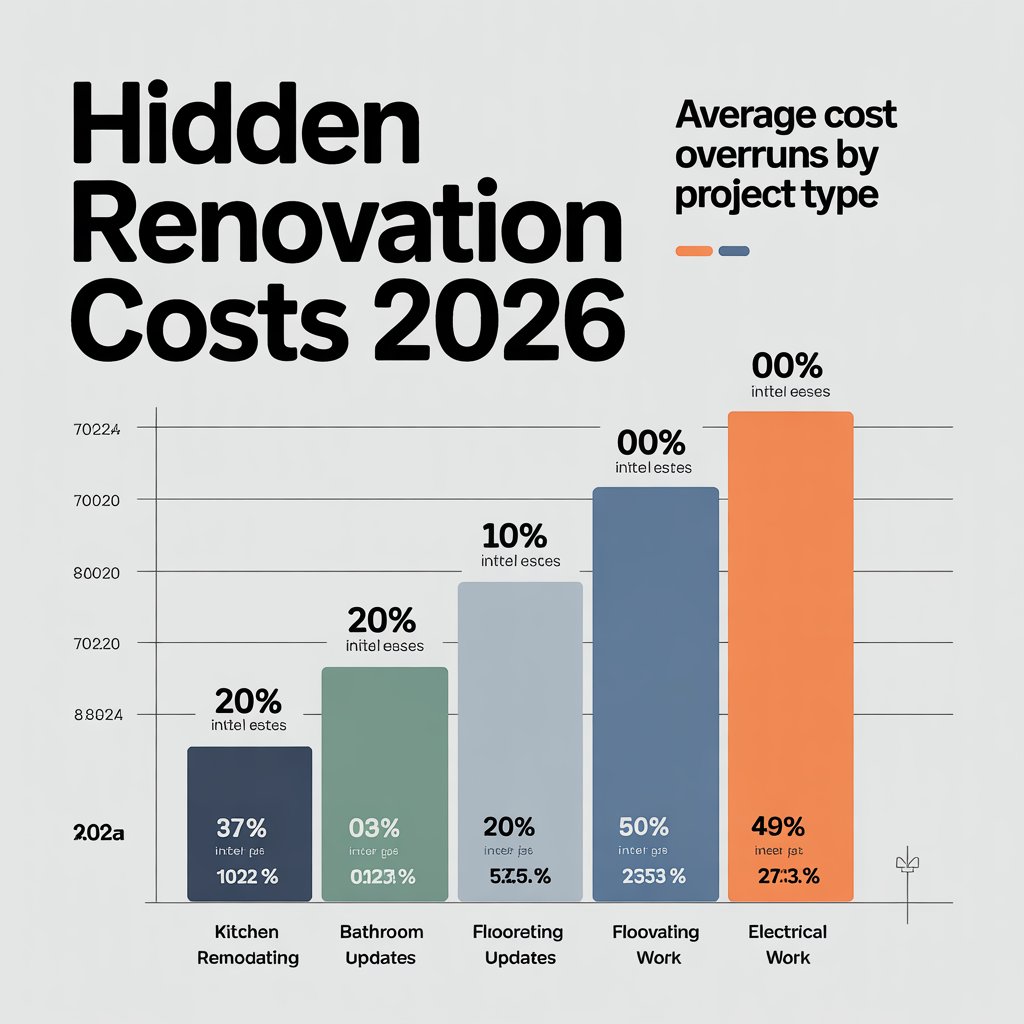
Permits, Inspections, and Code Compliance: The $5,000 Paperwork Trap
You’ve picked your quartz countertops and tile backsplash—now what? Paperwork. Permitting fees alone can drain $500–$5,000 from your budget, depending on your city. In Los Angeles, a kitchen remodel permit costs $1,200+; in Austin, it’s $800. But the real killer? Code compliance upgrades.
Modern building codes often force costly retrofits you didn’t plan for. For example:
- California homeowners face seismic retrofitting requirements during structural changes (adding $3K–$15K).
- Electrical rewiring becomes mandatory if your home’s wiring hasn’t been updated since the 1980s.
- Plumbing systems must meet new water-efficiency standards, triggering pipe replacements.
Worse, inspection delays due to overworked city staff can idle your crew for weeks—labor shortages mean paying contractors for downtime. One Ohio family waited 17 days for a final inspection, burning through $2,800 in idle labor costs.
Pro Tip: Ask your contractor to include a “code upgrade buffer” (5–10% of your budget) for surprise compliance work. In high-regulation states like California or New York, bump this to 15%.
| Category | Avg Cost | % of Budget |
|---|---|---|
| Standard Permits | $500–$2,500 | 3–5% |
| Code Upgrades | $2,000–$15,000 | 8–20% |
| Inspection Delays | $500–$5,000 | 2–7% |
Demolition and Structural Surprises: What Lies Beneath
That cheerful demo day? It’s where budgets go to die. Demolition costs ($5–$15/sq ft) seem straightforward—until your contractor hits:
- Rotting floor joists from undetected leaks (common in Florida’s humidity).
- Termite damage hidden behind walls (averaging $3K–$7K to repair).
- Asbestos abatement ($2K–$10K) in homes built before 1980.
A 2025 case in New England saw a bathroom remodel halt when demolition revealed lead paint and crumbling plaster. The fix? $8,200 in hazardous material removal—not included in the original $22K quote.
Why this happens: Older homes hide decades of DIY fixes and deferred maintenance. What looks like a simple wall removal might expose a load-bearing beam requiring steel reinforcement ($5K+).
Real Talk: Always budget 10–15% of your total project cost for structural surprises. In homes over 50 years old, make it 20%.
Utility Disruptions and Temporary Fixes: The Invisible Time Bomb
Turning off utilities seems simple—until your kitchen remodel strands you without gas for 3 days. Utility shutoffs trigger cascading costs:
- Water/gas disconnection fees: $150–$500 per service.
- Temporary housing during remodel: $100–$300/night for hotels (a 2-week kitchen project = $1,400–$4,200).
- Portable power setups: $200–$600/week for generators if electrical work cuts power.
In Texas, a 2025 survey found 65% of homeowners underestimated utility disruption costs by $1,200+. One family rented a RV for 10 days when their plumbing remodel went sideways—adding $3,500 to their budget.
Save Yourself: *Ask your contractor for a utility disruption timeline. Book Airbnb stays *in advance* during peak travel seasons to avoid inflated prices.*
Waste Disposal and Cleanup: The $800 You Forgot
That dumpster in your driveway? It’s costing more than you think. Waste disposal fees break down like this:
- Standard dumpster rental: $400–$800 (for 10–15 days).
- Hazardous waste surcharges: +$200–$500 for asbestos/lead materials.
- Post-demo cleaning: $300–$700 for dust/debris removal (critical for hardwood floors).
Skip proper disposal, and you risk fines—like the Denver homeowner who paid $1,200 for illegal dumping after mixing asbestos with regular debris.
Material and Labor Fluctuations: Why Your Lumber Quote Expired
In 2026, material price fluctuations are brutal. Post-2025 tariffs and supply chain snarls caused:
- Lumber prices to spike 20% in Q1 2026.
- Imported tile delays stretching 8–12 weeks.
- Contractor overruns due to labor shortages (40% of US contractors report 20%+ fewer workers than pre-pandemic).
A Midwest kitchen remodel in March 2026 saw cabinet costs jump $4,200 after the supplier changed vendors mid-project. Worse, the crew’s overtime fees added $2,800 when delays forced weekend work.
Your Shield: Lock prices in writing. Require contractors to specify: “This quote valid for 30 days.” For big-ticket items like countertops, pay a 10% deposit to secure current rates.
Kitchen and Bathroom-Specific Pitfalls: Where Dreams Meet Reality
Kitchen Remodel Hidden Costs
- Cabinet installation fees: Custom cabinets often require wall modifications (+$800–$2,000).
- Appliance hookups: Gas line extensions for ranges cost $300–$600 (not included in appliance sales).
- Countertop cutouts: Sink/stove cutouts add $150–$400 (varies by material).
Bathroom Renovation Pitfalls
- Subfloor repairs: Water damage under tile adds $1,200–$3,500 (common in Florida’s humid climates).
- Plumbing surprises: Replacing corroded pipes behind walls can double project costs.
- Ventilation upgrades: Modern codes require $400–$900 for moisture-resistant exhaust fans.
Finishing Touches and Extras: The Devil’s in the Details
You’ve survived demolition and utilities—now for the “easy” part. Except:
- Flooring installation fees: Subfloor leveling adds $1–$3/sq ft (often skipped in quotes).
- Painting prep work: Patching walls + removing old wallpaper costs $500–$1,200.
- HVAC upgrades: Ductwork modifications for new layouts run $1,000–$4,000 (critical in humid climates).
- Landscaping restoration: Replacing damaged lawns/sidewalks post-remodel: $800–$2,500.
A Seattle homeowner learned this the hard way when their $18K kitchen remodel needed $3,200 in HVAC tweaks to meet new ventilation standards.
Financial and Long-Term Overlooks: The Silent Budget Killers
Insurance Premium Hikes
Renovations increase your home’s value—and premiums. In California, a $50K remodel raised annual premiums by $400+ due to wildfire risk reassessment.
Financing Interest Rates
A $30K loan at 8.5% (2026’s average) adds $3,800 in interest over 5 years.
Tax Implications of Home Improvements
Only improvements that add value (e.g., a new roof) are tax-deductible upon sale. Repairs (like leak fixes) aren’t.
ROI on Renovations
Kitchens recoup $50\%$ to $70\%$ at resale; bathrooms $60\%$ to $75\%$. But overspending kills ROI—a $75K kitchen in a $300K home won’t pay off.
Golden Rule: Never spend more than 15% of your home’s value on a single room remodel.
DIY vs Pro: Hidden Tradeoffs That Cost You More
DIY seems cheap until:
- You miswire a GFCI outlet ($300 fix + fire risk).
- Imperfect tile work requires $1,200 in professional corrections.
- A botched plumbing job floods your basement ($10K+ in damage).
When DIY wins: Painting, demo (if no hazards), fixture swaps.
When pros save money: Electrical, plumbing, structural work.
Hard Truth: For every $1 saved DIY-ing, you risk $5 in corrections. Budget 20% more for DIY “mistake buffers.”
Budgeting Tips to Avoid Overruns: Your 5-Step Survival Kit
- 20% contingency fund: Non-negotiable for homes over 20 years old.
- Phased planning: Do structural/utility work first to uncover surprises early.
- Get 3 detailed bids: Require line-item quotes (not lump sums).
- Verify contractor licenses: Check for active insurance and bonding.
- Track daily: Use apps like Renovation Calculator Pro to log every expense.
Pro Move: Ask contractors: “What’s the #1 hidden cost you see in projects like mine?” Their answer reveals experience.
FAQ: Your Hidden Costs Questions, Answered
Q: How much contingency should I budget for home renovation costs?
A: 15–20% for newer homes; 20–25% for pre-1990 builds.
Q: Are permits really worth the cost?
A: Skipping them risks fines (2–3x permit fees) and failed inspections that halt sales.
Q: What’s the most common plumbing surprise?
A: Galvanized pipes corroding behind walls—replacing them adds $2K–$6K.
Q: Do hidden costs in home renovation affect resale?
A: Yes! Unpermitted work can tank offers. Document all upgrades for buyers.
Q: Can I avoid asbestos testing?
A: Only if your home was built after 1980. Testing costs $300–$800—cheap vs. $10K abatement.
Conclusion: Build Smarter, Not Harder
Hidden costs in home renovation aren’t inevitable—they’re predictable. By budgeting for permits, structural surprises, and utility disruptions, you’ll dodge the 80% of homeowners who blow their budgets. Remember: the best remodels aren’t the cheapest, but the most planned.
Ready to remodel with confidence?
👉 Download our free 2026 Renovation Budget Template (includes regional cost calculators for California seismic zones and Florida humidity adjustments)—just enter your email below!
By Alex Johnson, Home Renovation Expert | Updated April 2026
Alex has guided 500+ US homeowners through stress-free remodels since 2018. His work has been featured in Remodeling Magazine and HGTV Home.