As an interior designer with over a decade of experience transforming homes across America, I’ve witnessed countless clients overpay or settle for subpar work simply because they didn’t know how to negotiate with contractors effectively. Your dream kitchen or bathroom remodel shouldn’t come with financial regret. Whether you’re updating a single room or undertaking a whole-home renovation, understanding the art of contractor negotiation can save you thousands of dollars while ensuring you get the quality craftsmanship your vision deserves.
In today’s competitive home improvement market where project costs have risen, mastering negotiation isn’t about being difficult—it’s about building partnerships that deliver maximum value. I’ve helped clients save an average of 18% on their renovation budgets through strategic negotiation, without compromising on the high-end finishes they desired. This guide distills professional strategies I use daily to help homeowners like you navigate contractor pricing, avoid common pitfalls, and create beautiful spaces that stay within budget.
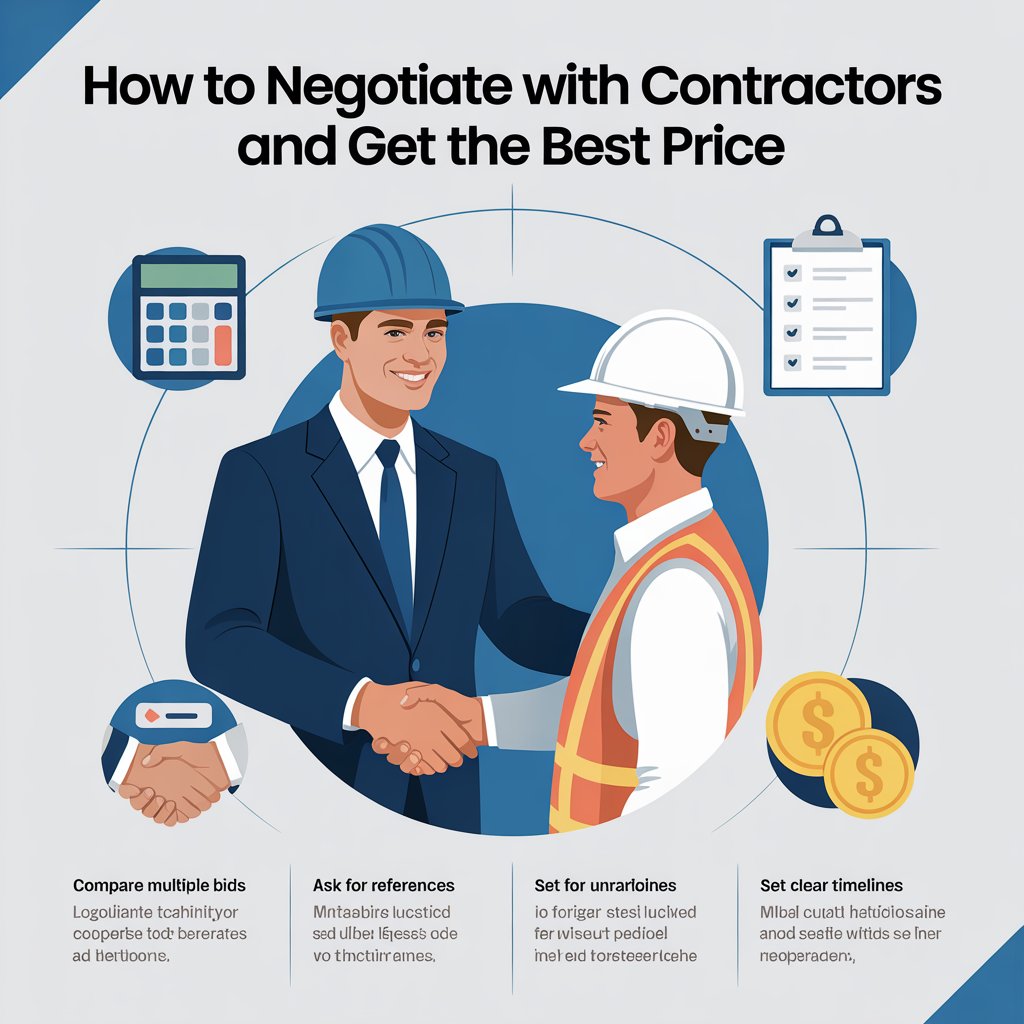
Do Your Homework: The Foundation of Successful Negotiation
Before reaching out to contractors, arm yourself with knowledge about typical renovation costs in your area. Research websites like HomeAdvisor and Angi show that bathroom remodels average $12,000 nationally but can range from $6,639 to $32,000 depending on materials and scope [synchrony.com]. Understanding these benchmarks prevents contractors from inflating prices based on your perceived lack of knowledge. Homeowners who cite specific price ranges during consultations demonstrate they’ve done their research, immediately commanding more respect from professionals.
Create a detailed list of exactly what you want, including materials, timelines, and specific features. Visit showrooms, collect inspiration photos, and research material costs beforehand. For instance, knowing that quartz countertops average $70-$120 per square foot while granite ranges from $40-$100 helps you evaluate if a contractor’s material markup seems reasonable. When contractors see you understand industry standards, they’re less likely to pad estimates with unnecessary costs.
Pro Tip: The 3-Bid Minimum Rule
Always obtain at least three detailed written quotes before making any decisions. As Josh Garskof notes in Money.com, “One of the major advantages to getting three or more bids for any significant (say, more than $5,000) home project is that you can tell the prospective contractors, honestly, that you’re doing so.” This transparent approach encourages competitive pricing without forcing contractors into uncomfortable haggling situations.
Verify contractors’ licenses through your state’s licensing board and confirm their insurance coverage—liability and workers’ compensation are non-negotiable. Review recent client testimonials focusing on how they handled budget discussions and unexpected costs. Skilled contractors welcome knowledgeable clients and view detailed scope documents as a sign of professionalism, not distrust.
Understanding How Contractors Price Projects
Contractors don’t simply add up material costs and labor hours; their pricing reflects risk assessment, overhead, and profit margins. As Evan Stark explains at Avance Floors, contractors evaluate “how likely is this client to change their mind mid-project?” and “how clear is the scope?” [avancefloors.com]. When documentation is vague, contractors build in contingency costs that can add 15-20% to your project. Understanding this mindset helps you frame requests that reduce perceived risk and encourage lower bids.
Here’s how a typical contractor breaks down pricing for a $50,000 renovation:
| Component | Typical Percentage | How to Negotiate |
|---|---|---|
| Materials | 35%-45% | Request alternative finishes with similar aesthetics |
| Labor | 25%-35% | Discuss phased scheduling for potential off-peak discounts |
| Overhead | 10%-15% | Streamline communication to reduce administrative costs |
| Profit | 5%-15% | Offer prompt payment terms for modest reductions |
Contractors often price based on project complexity rather than square footage alone. A straightforward bathroom update with accessible plumbing might cost $25,000, while the same square footage with structural changes could reach $50,000. Presenting detailed plans reduces uncertainty, allowing contractors to submit more aggressive bids. As Jeff Lexvold emphasizes, “A contractor’s number is not just about ‘how much it costs.’ It is also ‘how much risk do I want to take with this project and this person'” [tropicrenovations.com].
Pro Tip: The Cost Breakdown Request
Don’t just ask for a total price—request an itemized bid that separates materials, labor, permits, and contingencies. Jon Grishpul from GreatBuildz advises: “Break down the quote into materials, labor and timelines, and ensure all the quotes you’ve received are costing out the same list of items” [greatbuildz.com]. This transparency reveals where contractors might be padding estimates and identifies legitimate cost drivers.
This granular understanding empowers you to negotiate strategically—perhaps accepting slightly higher labor costs if materials can be sourced more affordably. Remember that extremely low bids often signal hidden costs or compromised quality, while higher bids might reflect superior craftsmanship worth the investment.
The Strategic Value of Multiple Bids
Telling contractors you’re obtaining multiple bids isn’t aggressive—it’s standard industry practice that encourages competitive pricing. Rather than saying “Your price is too high,” frame it positively: “I’m gathering three detailed proposals to ensure I select the best partner for this important project.” This approach maintains professionalism while signaling that price matters. Kat Tancock notes at Synchrony that “the process of competing for your business will almost certainly drive down everyone’s price” [synchrony.com], but remember that lowest bid shouldn’t automatically win your business.
Create a bid comparison spreadsheet tracking not just price, but included features, timeline, payment schedule, and warranty terms. I’ve seen clients save money with slightly higher bids because the contractor included premium features at no extra charge or offered extended warranties. Evaluate each proposal against your must-have elements versus nice-to-haves. For example, a $2,000 higher bid might include superior waterproofing that prevents $10,000 in future damage—a clear value worth the incremental cost.
# Bid Comparison Checklist

| Feature | Contractor A | Contractor B | Contractor C |
|---------|-------------|-------------|-------------|
| Total Price | $ | $ | $ |
| Included Materials |  |  |  |
| Project Timeline |  |  |  |
| Payment Schedule |  |  |  |
| Warranty Coverage |  |  |  |
| Permit Responsibility |  |  |  |
| Change Order Process |  |  |  |
Pro Tip: The “Preferred Partner” Approach
After reviewing all bids, call your top choice and say: “I’ve received competitive proposals, but I’m leaning toward working with you because [specific reason]. To make this work within my budget, could we find $X in savings?” This positions you as a serious client who values their work while opening dialogue for reasonable adjustments. As Josh Garskof advises, “Hire the one whose work and reputation are the best. But the process of competing for your business will almost certainly drive down everyone’s price” [money.com].
Remember that contractors track conversion rates—those who submit bids expecting 1 in 3 will become clients. By signaling you’re close to decision time (“I need to finalize by Friday”), you create gentle urgency that can motivate additional concessions without compromising quality.
Value Engineering: Smart Cost-Saving Without Sacrificing Design
Rather than asking contractors to “lower your price,” request value engineering recommendations—design alternatives that maintain aesthetics while reducing costs. Instead of “Can you make this $5,000 cheaper?” try “My target budget is $25,000 for this $30,000 proposal—can you suggest changes that would bring us closer to that while preserving the design vision?” This collaborative approach yields better results than blunt price negotiations. As the Money.com article states, contractors may “suggest a similar-looking-yet-more-affordable tile for your new master bathroom or a different layout that keeps the fixtures where they are and therefore slashes the plumbing costs” [money.com].
Consider these high-impact, low-cost alternatives for common renovation elements:
- Countertops: Substitute premium quartz with well-chosen laminate or butcher block in secondary areas
- Fixtures: Select mid-range plumbing fixtures with designer aesthetics (many budget lines mimic luxury styles)
- Layout: Maintain existing plumbing locations even with cosmetic updates (moving pipes costs 3-5x cosmetic changes)
- Lighting: Use statement pendant lights in key areas with budget recessed lighting elsewhere
- Flooring: Install premium materials in main living areas with more affordable options in secondary spaces
Pro Tip: The “Design Sacrifice” Strategy
Identify 2-3 elements you’re willing to compromise on and communicate these early: “I’d love custom cabinetry, but if that pushes us over budget, I’m open to semi-custom options with premium paint.” Contractors appreciate this transparency and will prioritize preserving your non-negotiable elements. Jeff Lexvold from Tropic Renovations confirms that “the biggest savings often come from simplifying the design, not haggling over every dollar” [tropicrenovations.com].
For interior design projects specifically, focus savings on elements with minimal visual impact—behind-the-scenes improvements like insulation or framing rarely affect aesthetics but consume significant budget. Redirect those savings toward visible elements like hardware, countertops, and lighting that define your space’s character.
Negotiating Beyond Price: Timeline, Payment & Scope
Seasoned homeowners know that negotiating only the final price misses opportunities for significant value enhancement. Contractors often have flexibility on schedule—offering to start during their slower season (typically January-March) might secure 5-10% savings as contractors aim to keep crews employed during slower periods. Similarly, proposing an extended payment schedule aligned with project milestones can ease cash flow while giving contractors predictable income. Jon Grishpul emphasizes: “Be open to compromise and alternatives” including “payment schedule, timeline, and timeline” [greatbuildz.com].
Consider negotiating these often-overlooked elements:
- Warranty extensions – A modest price increase might secure doubled warranty coverage
- Included touch-ups – Request post-completion touch-up sessions at no extra charge
- Change order thresholds – Negotiate free minor adjustments (under $200) without formal change orders
- Material leftovers – Request leftover materials be returned to you rather than kept as profit
- Project photography – Ask for professional before/after photos for your records (contractors often take these anyway)
# Negotiation Variables Beyond Price

| Element | Typical Terms | Potential Improvements |
|---------|--------------|------------------------|
| Timeline | Standard scheduling | Off-season discounts |
| Payment Schedule | 30% down, 40% mid, 30% final | 10% down, milestone payments |
| Change Orders | $50-100 processing fee | Waived under $200 |
| Warranty | 1 year standard | Extended to 2 years |
| Cleanup | Basic daily cleanup | Enhanced post-project cleaning |
Pro Tip: The “Scope Adjustment” Tactic
Rather than demanding lower prices, propose scope modifications that reduce work complexity. Evan Stark from Avance Floors recommends: “Your leverage comes from having options and no desperate deadlines” [avancefloors.com]. For example, delaying non-essential elements like custom molding until phase two can lower initial costs while keeping the contractor engaged for future work.
This holistic approach creates win-win scenarios where contractors maintain profitability while you gain additional value. I’ve seen clients secure free design consultations or expedited timelines through creative negotiation that focused on contractor priorities rather than just price reduction.
Protecting Your Investment: Contracts Done Right
Never begin work without a detailed written contract specifying every aspect of the project. Your contract should include:
- Complete project description with measurable specifications
- Precise timeline with start/completion dates and milestone dates
- Payment schedule tied to specific completion benchmarks
- Detailed material specifications (brand, model, finish)
- Clear change order process with approval requirements
- Insurance and licensing verification
- Warranty terms and maintenance requirements
According to contractor negotiation experts at GreatBuildz, “anything not in writing will come back as a ‘change order’ later” [greatbuildz.com], often at premium rates. I’ve witnessed countless clients pay 20-30% more for “unexpected” elements that should have been included in the original scope.
Pro Tip: The Contract Verification Checklist
Before signing, verify these critical elements:
- Licensing: Confirm active license through your state registry
- Insurance: Require proof of current general liability ($1M+) and workers’ comp
- Permits: Clarify who obtains permits (should be contractor for structural work)
- Lien Waivers: Require unconditional lien waivers with each payment
- Dispute Resolution: Specify mediation process before legal action
As Evan Stark warns: “Big discounts with vague contracts are usually a warning sign, not a win” [avancefloors.com].
Conclusion: Your Path to Confident Contractor Negotiation
The journey from overwhelmed homeowner to confident negotiator is closer than you think. As we’ve explored throughout this guide, successful contractor negotiation isn’t about hardball tactics—it’s about strategic communication, thorough preparation, and mutual respect for the value each party brings to the project. Remember Josh Garskof’s wisdom from Money.com: “One of the major advantages to getting three or more bids for any significant home project is that you can tell the prospective contractors, honestly, that you’re doing so” [money.com]. This transparency builds trust while creating healthy competition that works in your favor.
Your home is your sanctuary, and the renovation process should enhance rather than deplete your spirit. By applying these negotiation principles, you transform from a passive recipient of quotes to an informed decision-maker who sets the terms of the partnership. The most successful projects I’ve overseen weren’t those with the lowest prices, but those where client and contractor aligned on goals, communicated clearly, and viewed pricing as part of a larger value equation—not just a number on a proposal.
Pro Tip: The 48-Hour Negotiation Window
When you’re ready to negotiate, schedule a call with your preferred contractor and state: “I’ve reviewed all proposals and believe your work aligns best with my vision. To move forward, I need to finalize details within the next 48 hours.” This creates constructive urgency without pressure. Contractors appreciate decisive clients and often present their best terms when they know a decision is imminent. Evan Stark emphasizes that “having multiple bids gives you leverage, but you shouldn’t abuse that leverage to squeeze contractors” [avancefloors.com]. Professionalism throughout negotiation builds the foundation for an excellent working relationship.
Your renovation story doesn’t have to follow the all-too-common narrative of blown budgets and disappointing results. Armed with knowledge of how contractors price work, the strategic value of multiple bids, and techniques for value engineering without sacrificing design, you’re prepared to navigate negotiations with confidence. I’ve seen clients transform $50,000 projects into $41,000 realities through informed negotiation—not by cutting corners, but by redirecting resources to what truly matters in their spaces.
Before you sign any agreement, review this final checklist:
- ✅ Verified contractor license and insurance through official state channels
- ✅ Received and compared at least three detailed, itemized bids
- ✅ Identified at least two “sacrifice elements” where you can compromise without impacting design vision
- ✅ Negotiated beyond price (timeline flexibility, payment terms, warranty)
- ✅ Included clear scope definition with measurable specifications
- ✅ Documented all agreements in writing with no “we’ll figure it out later” items
# Your Negotiation Success Metrics

| Element | Target | Achievement |
|---------|--------|-------------|
| Budget Adherence | Within 5% of target | ✓ |
| Design Integrity | No compromise on key elements | ✓ |
| Contractor Relationship | Positive and professional | ✓ |
| Project Timeline | On schedule | ✓ |
| Final Satisfaction | 9/10 or higher | ✓ |
Your home deserves thoughtful design executed by skilled professionals at a fair price. By approaching negotiations as collaborative problem-solving rather than adversarial haggling, you create the conditions for exceptional results. The beautifully renovated spaces I’m most proud of weren’t the most expensive—they were the projects where client and contractor aligned on value from the very beginning.
As you embark on your next home transformation, remember this final piece of wisdom from seasoned contractor Jeff Lexvold: “Understand that a contractor’s goal is not just to get the job, but to get a job they can profitably complete to your satisfaction” [tropicrenovations.com]. When you structure negotiations around this shared objective, everyone wins—especially you, who gets to enjoy your dream space without financial regret.
Take a deep breath, gather your research, and step confidently into your next contractor conversation. Your beautifully designed, well-budgeted home awaits—and with these strategies in hand, you’re ready to make it a reality.